
An FDA panel just voted 8–6 to open a compounding pathway for BPC-157 and KPV. Precision Peptide has spent two years building products around both.
Disseminated on behalf of The Precision Peptide Company

SYMBOL | CSE: BPC | OTCQB: PNGAF
- Outstanding Shares: 52,631,207
- Warrants: 8,396,600
- Options: 2,733,333
- Fully Diluted: 54,699,540
- ThePrecisionPeptideCompany.com
The Precision Peptide Company (CSE: BPC) is a Vancouver-based natural supplement company that operates in Surrey, British Columbia. As the parent company of Amino Innovations, the Precision Peptide team delivers science-backed, non-invasive, highly effective solutions that naturally align with biology.
No gimmicks. No shortcuts. Just real results.BPC
RECENT FINANCING AND INSIDER TRANSACTIONS
Insider Buying. No Warrants. Real Capital at Risk.
The Precision Peptide Company Inc. has just completed, on July 15, 2026, a CAD $2 million LIFE financing at CAD $0.50 per share price — and with no warrants attached.
EMC subscribed for approximately 33.6% of this offering. The Company has 8,396,600 warrants outstanding from prior financings
EMC’s Position in the Company
Emerging Markets Consulting participated directly in this financing by investing:
CAD $671,356 — Purchasing: 1,342,712 shares at CAD $0.50 per share, representing approximately 33.6% of the CAD $2,000,000 offering
(Note: $671,356 of a $2,000,000 round is 33.6%.)
In addition, we separately acquired:
1,000,000 additional shares through a private transaction
EMC’s total holding of 2,342,712 shares represents approximately 4.47% of the 52,431,207 common shares outstanding.
We will not sell these shares while we remain the Company’s Investor Relations firm of record. EMC may terminate that engagement at its own discretion and may thereafter sell its shares at any time, without notice.
EMC is compensated by the Company and holds shares in the Company. These are conflicts of interest. EMC’s interests may differ materially from those of other shareholders. Readers should assume EMC is not disinterested.
Management Is Buying Too
Company’s Chief Executive Officer reported the open-market purchase of common shares for a total consideration of CAD $40,725, as disclosed on SEDI.
While insider purchases never guarantee future performance, readers may review the Company’s complete SEDI record, including dispositions, at sedi.ca.
Terms of the July 2026 Financing
✔ A financing completed at CAD $0.50 per share on July 15, 2026
✔ No warrants issued in this offering; 8,396,600 warrants remain outstanding from prior financings
✔ Insider buying by management
✔ A substantial investment by the Company’s Investor Relations firm
Peptides Sector Background
The peptide therapeutics market is projected to grow annually through 2033 (Grand View Research, source 10).
From metabolic health and longevity to weight management, hormone optimization, regenerative medicine, and performance medicine, peptides are used across a range of applications.
Growth in the broader peptide market does not indicate that the Company will capture any portion of it. The Company has no FDA-approved product and no clinical-stage pipeline.
Summary of Disclosed Facts
The facts disclosed above are:
- A CAD $2 million financing completed at CAD $0.50 per share on July 15, 2026
- No warrants issued in that offering; 8,396,600 warrants outstanding from prior financings
- Insider buying of CAD $40,725
- A subscription for approximately 33.6% of the offering by Emerging Markets Consulting, the Company’s compensated investor relations firm
- A commitment not to sell while serving as the Company’s Investor Relations firm, terminable by EMC at its own discretion
We encourage investors to conduct their own due diligence, review the Company’s public filings on SEDAR+ at sedarplus.ca and on otcmarkets.com, and determine whether an investment in the Company is suitable for them.
Market Position
On July 23–24, 2026, FDA’s Pharmacy Compounding Advisory Committee (“PCAC”) reviewed seven bulk drug substances for possible addition to the 503A Bulks List and voted to recommend six, including BPC-157 (8–6, one abstention) and KPV (8–6, one abstention)
These votes are non-binding recommendations of an advisory committee. They are not FDA approval, not a finding of safety or effectiveness, and not binding on FDA. FDA’s own review staff recommended against adding all seven substances, citing an absence of human clinical evidence for several and, for BPC-157, studies that were small, uncontrolled or contradictory. Any change in status requires notice-and-comment rulemaking, commonly 8 to 12 months, with no assurance of completion.
The Company has no FDA-approved product. A 503A listing, if it occurs, would permit compounding pharmacies to prepare these substances pursuant to a prescription. It would not authorize direct-to-consumer sale of dietary supplements containing them.
Peptide Therapeutics in Global Drug Sales
The following describes the broader peptide sector. The Company sells none of the drugs discussed, has no approved drug and no clinical-stage pipeline, and has no relationship to Novo Nordisk, Eli Lilly or their products. The performance of these companies has no bearing on the Company’s prospects.
Analysts projected in 2024 that GLP-1 therapies would displace PD-1 inhibitors at the top of global drug sales rankings. (source 5).
Semaglutide, the GLP-1 behind Wegovy and Ozempic, contributed to Novo Nordisk becoming the most valuable company in Europe in September 2023, briefly surpassing LVMH⁶.
Tirzepatide, the GLP-1 in Zepbound and Mounjaro, contributed to Eli Lilly passing US$1 trillion in market capitalization on November 21, 2025 — the first healthcare company in history to cross that threshold⁷.
In the third quarter of 2025 alone, tirzepatide generated approximately US$10.1 billion, exceeding Keytruda’s sales for the same quarter⁸.
Accelerating Into the Mainstream
Consumer demand for peptide therapies has moved into mainstream channels. Search volume for BPC-157 hit an all-time high in June 2024, and combined TikTok and YouTube views for #BPC157 have surpassed 50 million, according to a 2025 systematic review in HSS Journal¹¹.
That systematic review is a clinical-evidence review, and it concluded that human clinical evidence for BPC-157 is lacking. FDA review staff separately characterized the available human evidence as small, uncontrolled or contradictory. Social media engagement is not evidence of product efficacy, market size, or Company revenue.
Needle-Free Delivery Unlocks Widespread Adoption
Peptides became the biggest drug class in pharma – even with self-injection as the primary delivery method. But for many consumers, that requirement remains a barrier.
The published data on how adults feel about needles is unambiguous:
- 2% of adults experience needle phobia, according to a 2022 international study of 2,098 adults published in PLOS ONE¹⁶.
- Between 11.5 and 66 million U.S. adults may suffer from the clinical condition, per the Journal of Primary Care & Community Health¹⁷.
- Patients prefer a daily oral medication over a weekly injectable by approximately 3 to 1 when efficacy is equivalent, per the peer-reviewed REVISE study¹⁸.
That is a key barrier to growth in the peptide market – one The Precision Peptide Company (CSE: BPC | OTCQB: PNGAF) has built its product portfolio to address.
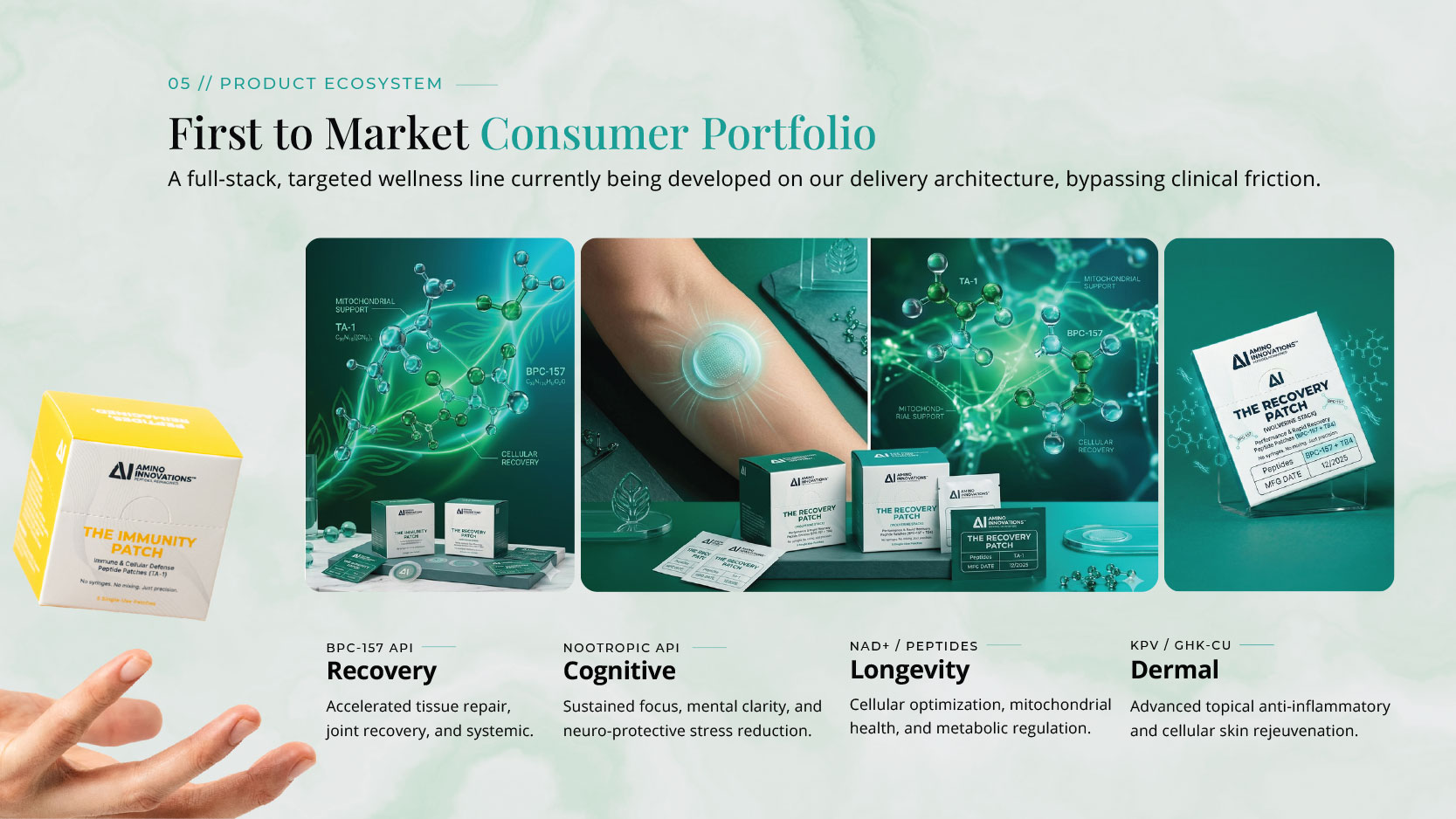
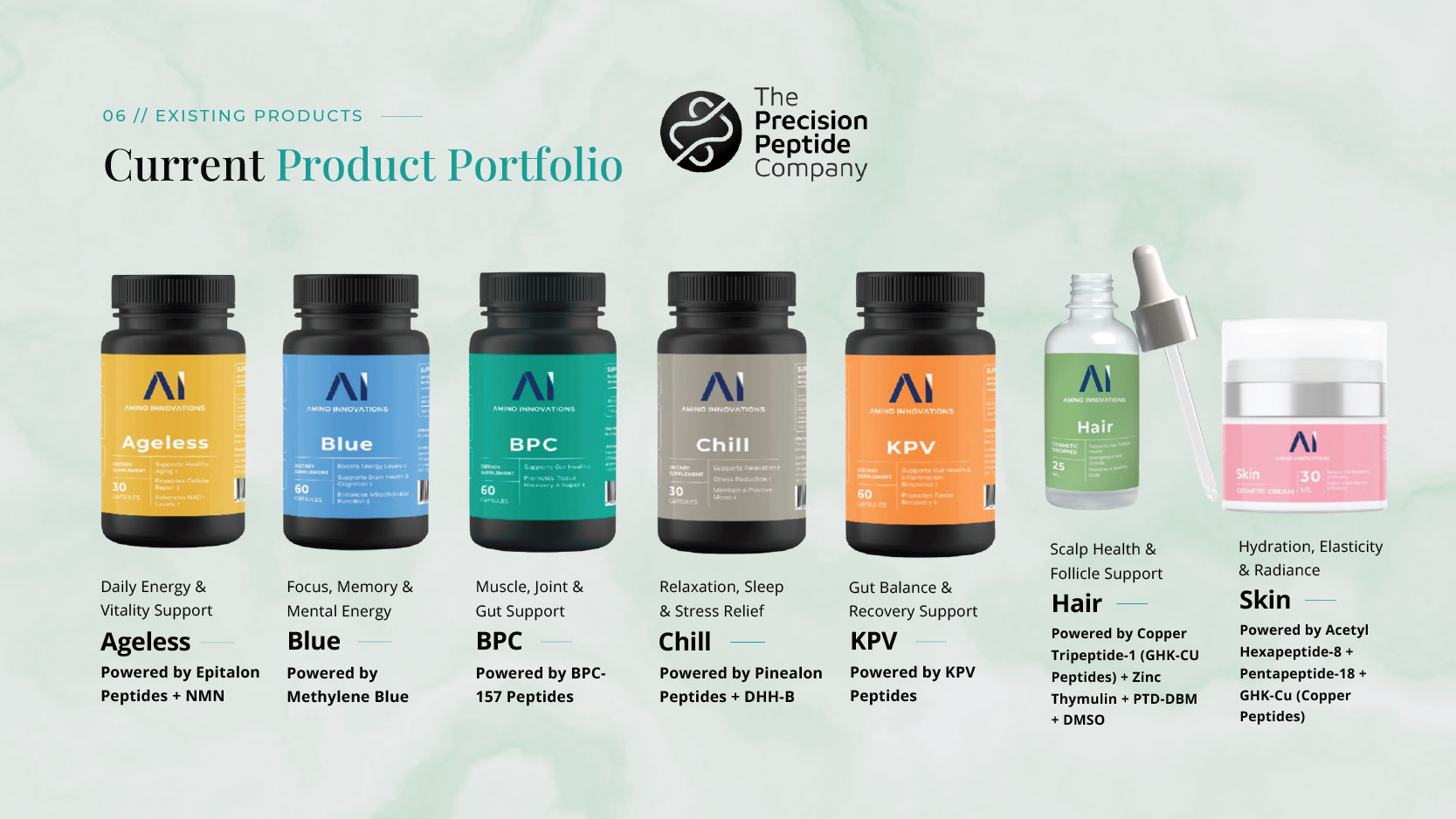
Through its subsidiary, Amino Innovations, Precision Peptide develops the following formulas in patent-pending oral and topical formats:
- BPC-157 (Recovery)
- GHK-Cu (Dermal)
- KPV (Anti-Inflammatory)

And in October 2025, the Company announced its next-generation peptide patch platform — an innovation that expects to redefine peptide delivery¹⁹.
The Amino Innovations Patch uses bio-dissolving lattice technology to deliver peptides through the skin’s surface layers.
No pain. No mixing. No needles.
Its proprietary design achieves one-to-one equivalence to traditional injectable dosing. Thereby eliminating the reconstitution, sterile handling, and dosing measurement that have made peptides a clinical specialty rather than an everyday wellness product¹⁹.
The patches are compact, TSA-friendly, and shelf-stable for up to six months — no refrigeration, no preparation, no pharmacy visit needed.
Every patch is developed in the United States, manufactured in a cGMP-certified facility, and subject to rigorous third-party testing for pharmaceutical-grade purity, stability, and consistency¹⁹.
Peptide's Explained
A Bright Future Ahead...
“My hope is that they will get moved to a place where people have access from ethical suppliers.”
— Secretary Kennedy, JRE #2461, February 27, 2026²
Research Has Been Building for Decades
Peptides are among the most studied molecules in modern medicine. These short amino acid chains act as biological messengers — regulating inflammation, tissue repair, metabolism, immune function, and cellular signalling.
According to the THPdb database published in PLOS ONE, the FDA has approved hundreds of peptide and peptide-protein therapeutics to date²⁵.
Insulin. Semaglutide. Tirzepatide. Liraglutide. Teriparatide. Octreotide. Leuprolide. Desmopressin. Oxytocin. Bremelanotide. Tesamorelin.
All peptides. All approved. All already in the pharmaceutical mainstream.
The specific compounds now under PCAC review carry decades of independent research behind them:
- GHK-Cu was first characterised in a 1980 Nature paper by Loren Pickart as a copper-binding plasma tripeptide. Subsequent research has linked it to the modulation of more than 4,000 human genes, with research exploring its role in wound healing and dermatological health.²⁶
- BPC-157 has been studied continuously since 1991 by the research group of Dr. Predrag Sikiric at the University of Zagreb, with dozens of peer-reviewed publications on tissue healing and angiogenesis²⁷.
- MOTS-c was discovered by USC researchers and published in Cell Metabolism in 2015 as the first functional mitochondrial-encoded peptide beyond humanin²⁸. New research is focusing on potential applications in metabolic disorders, including type 2 diabetes and metabolic syndrome
- Epitalon research, pioneered by Dr. Vladimir Khavinson in St. Petersburg, was independently replicated in 2025 by researchers at Brunel University London²⁹. It’s now being studied for its potential effects on age-related cellular decline.
This is not a new frontier. It is the most-published, longest-studied “new” drug class in medicine.
Management & Board of Directors
Pratap Sandhu
Chief Executive Officer
A visionary entrepreneur with deep roots in food manufacturing, Pratap transformed his family’s business from a small operation to a global success. With his BCIT background in marketing and professional sales, he leads Pangea’s strategic direction and growth initiatives.
Nashir Virani
Director
Food industry pioneer and former CEO of Golden Boy Foods, which he grew from a coffee business to a diversified food manufacturer before its US$500 million acquisition by Kraft in 2015. Currently CEO of First Choice Foods, Nashir brings invaluable industry expertise.
Ajit Bhatti
Director
A technology and investment veteran with 19 years of leadership experience, Ajit specializes in large-scale project implementation and venture capital investments. His expertise spans healthcare, technology, and mineral exploration.
Recent News
- The Precision Peptide Company Advances Needle-Free GLP-1 Tirzepatide Patch into Formal U.S. Testing – October 13, 2026
- The Precision Peptide Company Orders 20,000 Thymosin Alpha-1 Patches for Commercial Launch – October 7, 2026
- The Precision Peptide Company Expands U.S. Wholesale Program, Opening Distribution of Its Needle-Free Range to Clinics, Med Spas, Gyms and Retailers – September 29, 2026
- The Precision Peptide Company Becomes Strategic Sponsor of Championing Mental Health 3 Boxing Event – September 22, 2026
- The Precision Peptide Company Announces Sponsorship of Boulderthon, Boulder Colorado’s Marathon Weekend – September 15, 2026
- The Precision Peptide Company Advances Thymosin Alpha-1 Patch into Formal U.S. Testing – September 8, 2026
- The Precision Peptide Company Announces Grants of RSUs and Stock Options – September 4, 2026
- The Precision Peptide Company to Showcase Its Needle-Free Recovery Patch and Supplement Range at FitExpo Anaheim – August 25, 2026
- The Precision Peptide Company Inc. Announces Development of Needle-Free Tirzepatide Transdermal Patch – August 19, 2026
- The Precision Peptide Company Completes Migration of Amino Innovations Online Store and Customer Base to Company Website – August 7, 2026
- The Precision Peptide Company Targets Launch of the Peptide Pen, Expanding Its U.S.-Made Product Platform – August 4, 2026
- The Precision Peptide Company Opens Nationwide Retail Sales Days After FDA Panel Backs Six of Seven Peptides Under Review – July 30, 2026
- The Precision Peptide Company Advances First-to-Market Thymosin Alpha-1 Patch for Immune Support – July 28, 2026
- The Precision Peptide Company Applauds FDA Advisory Committee Vote on Expanded Pathway for BPC-157 and KPV – July 24, 2026
- The Precision Peptide Company Activates Nationwide Direct-to-Consumer Peptide Sales with Retail Telehealth Website Launch – July 21, 2026
- The Precision Peptide Company Inc. Receives 20,000-Unit Production Run of BPC-157 Transdermal Patches – July 14, 2026
- The Precision Peptide Company Provides MMA.INC Partnership Update Ahead of Conor McGregor’s UFC 329 Return – July 8, 2026
- The Precision Peptide Company Activates Nationwide Direct-to-Consumer Peptide Sales with Retail Telehealth Website Launch – July 7, 2026
- The Precision Peptide Company’s Needle-Free Recovery Patch Featured in Men’s Health Magazine – June 30, 2026
- The Precision Peptide Company Achieves LegitScript Healthcare Merchant Certification – June 23, 2026
- The Precision Peptide Company Announces Release of The Human Upgrade with Dave Asprey Episode Featuring Chief Scientific Officer Justin Kirkland – June 16, 2026
- The Precision Peptide Company Inc. Announces up to $2 Million LIFE Offering of Common Shares – June 11, 2026
- The Precision Peptide Company Establishes Compliant U.S. Peptide Access with Telehealth and Prescription Infrastructure Partnership – June 9, 2026
- The Precision Peptide Company Inc. Announces Extension of Investor Relations Agreement with Emerging Markets Consulting, LLC – June 5, 2026
- The Precision Peptide Company Inc. Signs Agreement with U.S.-Based 503A Sterile Compounding Pharmacy – Peptides to be 100% Compounded in the United States – June 2, 2026
- The Precision Peptide Company to Exhibit as the Only Peptide Company at Dave Asprey’s BEYOND Conference in Austin, Texas – May 28, 2026
- The Precision Peptide Company Inc. Places Order for 20,000 BPC-157 Transdermal Patches – May 26, 2026
- The Precision Peptide Company (BPC) Expands on Exclusive 50/50 Revenue Share Peptide Partnership with MMA.INC (MMA) – May 21, 2026
- The Precision Peptide Company (BPC) Lead Product Achieves 95.5% Purity in Independent Lab Testing, Clearing the Industry Benchmark and Advancing Toward Commercial Launch – May 19, 2026
- The Precision Peptide Company’s Chief Scientific Officer Justin Kirkland to Be Featured on The Human Upgrade with Dave Asprey – May 14, 2026
- The Precision Peptide Company Inc. Announces Exclusive Strategic Marketing Partnership with Mixed Martial Arts Group Limited – May 12, 2026
- The Precision Peptide Company Nears Commercial Launch of Needle-Free BPC-157 Patch as Final Testing Advances – May 7, 2026
- C$1.3 Million in Proceeds Received by The Precision Peptide Company from Warrant Exercises – May 5, 2026
- The Precision Peptide Company Grants RSUs and Stock Options and Settles Debt – May 4, 2026
Must Read OTC Markets/SEC policy on stock promotion and investor protection
COMPENSATION DISCLOSURE
EMC has been paid $575,000 by Pangea Wellness Inc. / The Precision Peptide Company Inc. for investor relations and marketing services. EMC subscribed CAD $671,356 for 1,342,712 common shares in the Company’s LIFE offering that closed July 15, 2026, and separately holds 2,000,000 shares acquired through a private transaction, for total holdings of 3,342,712 shares, and has committed to hold the position while serving as the company’s IR firm of record. | Please read our full disclaimer
Disclaimer and Forward Looking Statements
This website contains certain “forward-looking statements” and “forward-looking information” within the meaning of applicable Canadian securities legislation (collectively, “forward-looking statements”). All statements on this website, other than statements of historical fact, are forward-looking statements. Forward-looking statements include, but are not limited to, statements relating to:
- the Company’s corporate objectives, business strategy, and long-term aspirations, including its mission to expand access to next-generation peptide technologies;
- the Company’s research and development activities relating to its peptide-based formulations and drug delivery platforms, including its advanced transdermal and oral delivery systems;
- the anticipated applications and benefits of the Company’s peptide products and technologies;
- the Company’s plans to expand and scale its distribution network across North American clinical, consumer, and performance-driven markets;
- the anticipated market opportunity in the North American peptide-based wellness industry, including statements regarding the growth of the peptide segment;
- the Company’s plans to enter into licensing, partnership, collaboration, manufacturing, or other commercial agreements in connection with its products and delivery platforms;
- the Company’s plans with respect to future financing and the anticipated use of proceeds therefrom;
- expectations regarding revenues, expenses, and future financial performance; and
- any other information as to the future plans and outlook for the Company.
Forward-looking statements are frequently identified by words and phrases such as “aims,” “anticipates,” “believes,” “continues to,” “designed for,” “estimates,” “expects,” “focused on,” “forecasts,” “future,” “guidance,” “in development,” “intends,” “may,” “might,” “objective,” “outlook,” “plans,” “potential,” “projected,” “pursue,” “reimagined,” “scheduled,” “seeks,” “should,” “strategy,” “targets,” “will,” “will be achieved,” “will occur,” or variations of such words and expressions, or statements that certain actions, events, or results “could,” “would,” or “might” occur. Forward-looking statements are based on the current expectations, estimates, assumptions, and beliefs of management as of the date the relevant statement is made and are necessarily subject to a number of risks, uncertainties, and other factors.
Forward-looking statements are not guarantees of future performance. They involve known and unknown risks, uncertainties, and other factors that may cause the actual results, performance, or achievements of the Company to differ materially from those expressed or implied by such statements. Such risks and uncertainties include, without limitation:
- the early-stage nature of the Company’s product development activities, including the transdermal delivery platform currently under development, and the inherent uncertainties associated therewith;
- the ability to obtain, maintain, and enforce any patents or other intellectual property rights in respect of the Company’s product formulations and delivery technologies;
- competition from other companies with greater resources, more established distribution networks, and more advanced product pipelines in the peptide wellness and biopharmaceutical sectors;
- the ability to scale the Company’s distribution network across North America as anticipated and to respond to changes in consumer demand for peptide-based wellness solutions;
- the potential for adverse regulatory action in Canada, the United States, or other applicable jurisdictions in respect of the Company’s peptide products, including actions by Health Canada, the U.S. Food and Drug Administration, or the Federal Trade Commission relating to product classification, health claims, or advertising practices;
- changes in laws and regulations applicable to natural health products, consumer wellness products, drug development, and advertising;
- the availability of financing on acceptable terms, or at all, to fund the Company’s operations, product development, and distribution expansion;
- the impact of general economic and market conditions, including inflation and interest rate fluctuations, on consumer demand for wellness products;
- reliance on third-party contract manufacturers, researchers, distributors, and other service providers;
- risks associated with peptide synthesis and manufacturing scale-up, including challenges in maintaining purity, potency, and identity across production batches;
- foreign exchange fluctuations, given the Company’s operations and market focus across Canada and the United States; and
- other risk factors described in the Company’s public filings available on SEDAR+ at www.sedarplus.ca.
The above list of risk factors is not exhaustive. Many of these uncertainties and contingencies can directly or indirectly affect, and could cause, actual results to differ materially from those expressed or implied in any forward-looking statements.
Readers and investors are cautioned not to place undue reliance on forward-looking statements, as actual results and future events could differ materially from those anticipated in such statements. The forward-looking statements contained on this website are made as of the date this website was published and are expressly qualified in their entirety by this cautionary note. Except as required by applicable Canadian securities laws or the policies of the Canadian Securities Exchange, the Company disclaims any intention or obligation to update or revise any forward-looking statements, whether as a result of new information, future events, or otherwise.
Source References
- CNBC, November 21, 2025. Eli Lilly hits $1 trillion market value, first for health care company | BioPharma Dive, April 15, 2026. FDA moves toward easing restrictions on certain peptides
- The Joe Rogan Experience #2461, February 27, 2026. Episode with Robert F. Kennedy Jr.
- Fox News April 16, 2026. RFK Jr. House Ways and Means testimony coverage
- UPI, April 15, 2026. FDA to consider lifting restrictions on peptide injections (Scott Brunner quote)
- GlobalData / Fierce Pharma, March 2024. GLP-1s on track to take drug sales throne from PD-1 inhibitors
- Fortune, September 5, 2023. Novo Nordisk beats LVMH to become Europe’s most valuable company
- CNBC, November 21, 2025. Eli Lilly hits $1 trillion market value
- BioPharma Dive, October 30, 2025. Lilly hikes revenue forecasts (Q3 tirzepatide US$10.1B)
- eMarketer / Morgan Stanley, November 2025. GLP-1 boom makes Eli Lilly the first $1 trillion pharma company
- Grand View Research. Peptide Therapeutics Market 2025–2033
- Vasireddi et al., BPC-157: A Systematic Review, HSS Journal, 2025
- The New York Times, January 3, 2026. ‘Chinese Peptides’ Are the Latest Biohacking Trend
- Bloomberg, September 19, 2025. Do NAD and Peptides Work?
- CNN, April 13, 2026. The ‘Wild West’ of peptides is booming
- Roche, December 4, 2023. Carmot Therapeutics acquisition (one of several deals totalling $40B+). See: Roche/Carmot; Lilly/Versanis; Novo/Catalent; AZ/CSPC; Novo/Inversago; Novo/Cardior
- Alsbrooks & Hoerauf, PLOS ONE, 2022 (63.2% needle phobia among 2,098 adults). Prevalence, causes, impacts, and management of needle phobia
- Love & Love, J Primary Care Community Health, 2021 (11.5–66M U.S. adults). Considering Needle Phobia among Adult Patients During Mass COVID-19 Vaccinations
- Igarashi et al., REVISE study: Patient preferences oral vs injectable diabetes medications
- Pangea Natural Foods Inc. / Amino Innovations, October 21, 2025. Amino Innovations Develops Next-Generation Peptide Patch Platform
- The Joe Rogan Experience #1580 — Rogan on BPC-157. Episode commentary documented
- Huberman Lab Podcast, April 1, 2024. Benefits & Risks of Peptide Therapeutics
- The Doctor’s Farmacy, Ep. 914 with Dr. Edwin Lee. How Peptides Enhance Healing and Longevity
- Ben Greenfield, bengreenfieldlife.com. How To Use BPC-157
- The Tim Ferriss Show #826, September 10, 2025. Q&A with Tim — Supplements, Recovery, Peptides
- Usmani et al., THPdb: Database of FDA-approved peptide and protein therapeutics, PLOS ONE, 2017
- Pickart & Margolina, Regenerative and Protective Actions of the GHK-Cu Peptide, Int. J. Mol. Sci., 2018
- Sikiric et al., BPC 157 and Stable Gastric Pentadecapeptide, Pharmaceuticals, 2024
- Lee et al., MOTS-c: mitochondrial-derived peptide, Cell Metabolism, 2015
- Brunel University London Epitalon replication study, 2025. PMC12411320
- Pangea Wellness Inc. / TheNewswire, March 13, 2026. Name change to The Precision Peptide Company Inc., effective March 18, 2026
- https://www.grandviewresearch.com/industry-analysis/peptide-therapeutics-market#:~:text=The%20global%20peptide%20therapeutics%20market,options%20across%20major%20disease%20areas.