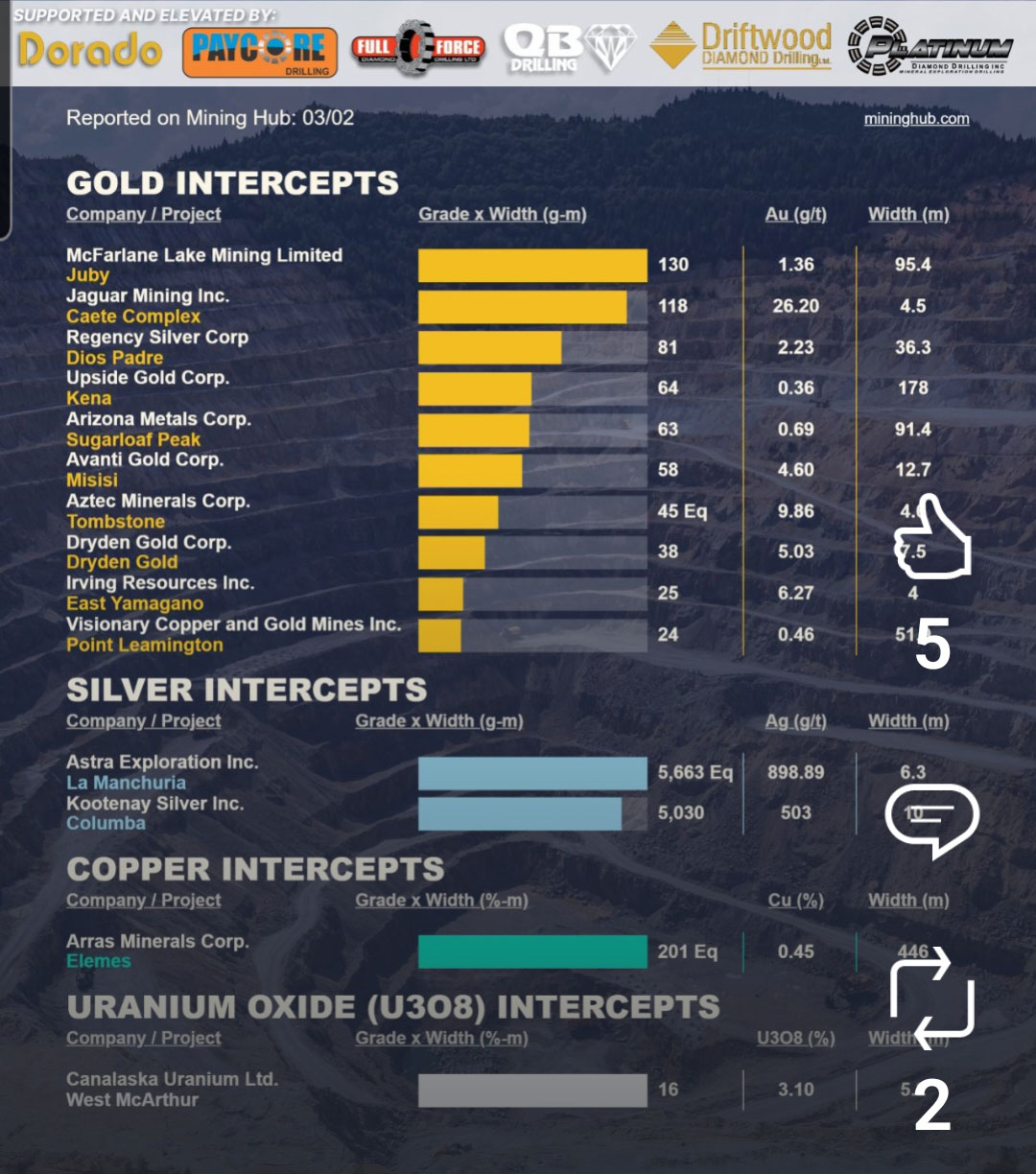
McFarlane Lake Mining

CSE: MLM | OTCQB: MLMLF

Disseminated on behalf of McFarlane Lake Mining Limited. This INFORMATION contains DATA prepared in accordance with Canadian Mining Standards.

McFarlane Lake Mining: A Compelling Gold Exploration & Mining Company

SYMBOLS:

CSE: MLM | OTCQB: MLMLF

The Big Picture: McFarlane Lake Mining is a Canadian gold explorer sitting on a significant gold deposit in Ontario’s world-renowned Abitibi region—one of the most productive gold districts on the planet.

What They’ve Found: Clear indicators of an extensive gold reserve running throughout their flagship Juby Project. To put it in perspective, at today’s gold prices (~$3,000+/oz), their estimates point toward a significant opportunity for company growth—with an expansive region that remains open for exploration and expansion.

Why It Matters Now: Their recent resource estimate was calculated conservatively at $2,500—and with gold now trading significantly higher, the economic potential of this project increases substantially. A sensitivity analysis at $3,750 gold shows tremendous potential for McFarlane to grow and expand operations that lead to additional opportunities for gold production on McFarlane owned properties.

The Path Forward: Beyond the flagship Juby project, the company owns additional Ontario gold properties, including a past-producing mine—providing multiple paths to value creation. As an early-stage exploration company with a large resource base in a mining-friendly jurisdiction, McFarlane is positioned to be a significant gold producers because of the prime property they own.

A Multi-Million Ounce Gold Resource in Canada's Premier Mining District Creates Substantial Opportunities for Growth

Experienced Explorers in a Proven Gold Producing District

McFarlane Lake Mining (CSE: MLM) has positioned itself at the epicenter of one of the world’s most prolific gold-producing regions—the Abitibi Greenstone Belt. With a newly acquired flagship property with significant gold indicators, this Canadian explorer offers investors the opportunity to be part of McFarlane’s journey to explore historically significant mineral deposits that many analysts believe is the early stages of a multi-year gold bull market.

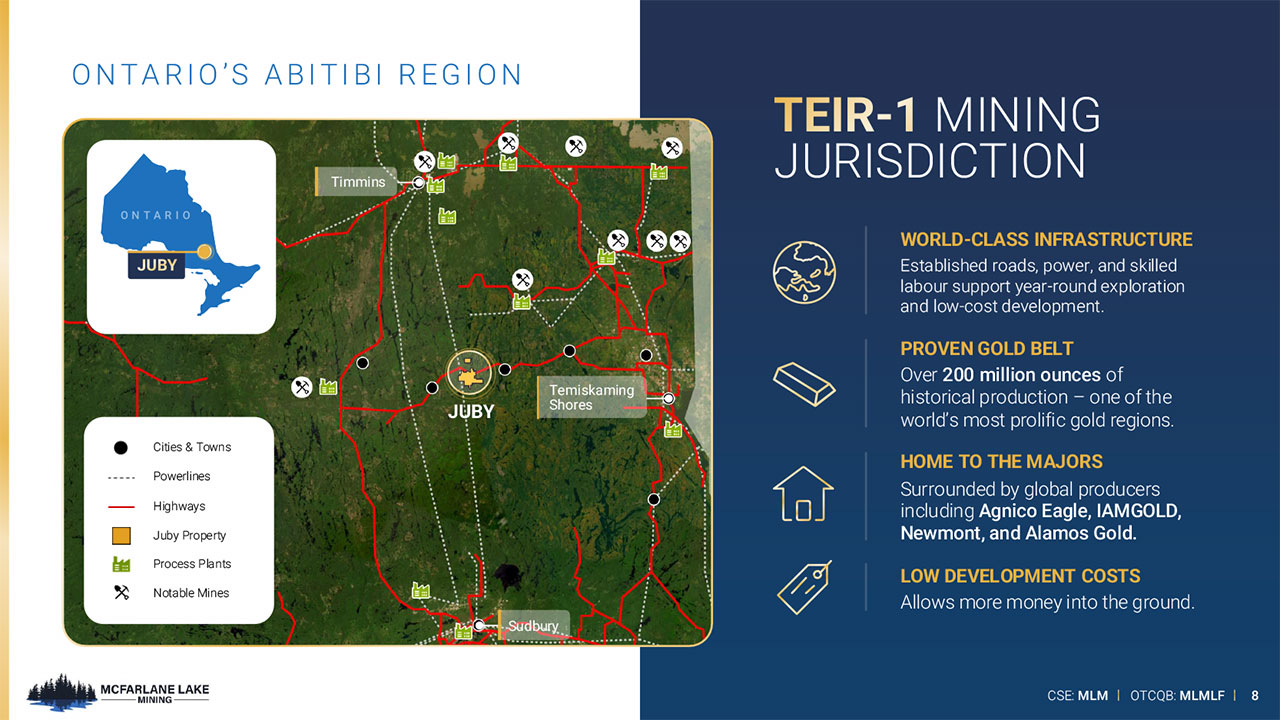
The Abitibi Belt has produced over 200 million ounces of gold since 1901 and hosts Canada’s largest gold mines. McFarlane’s Juby Gold Project sits in this same geological formation—the same rocks, the same fault structures, and the same mineral systems that created multi-billion-dollar deposits like Canadian Malartic and Detour Lake.

The Gold Market: Growing Momentum

For gold explorers like McFarlane Lake, higher gold prices don’t just improve economics—they transform previously marginal deposits into highly economic projects. At current gold prices, McFarlane’s resource sensitivity analysis shows the Juby Gold Project contains the type of ore associated with significant gold production—creating an opportunity to attract significant investor or M&A interest from major producers looking to replace depleting reserves. 
Looking for expert insights and early alerts?

Get Stock Alerts Instantly! Join EMC’s Exclusive WhatsApp and Telegram Groups For Saavy Investors

  • There’s no obligation, and EMC deliver actionable Small Cap Stock Alerts straight to your phone and you inbox at no cost!
  • Don’t miss out—subscribe and get an edge on your small cap investments!

The Juby Gold Project: Historically Significant

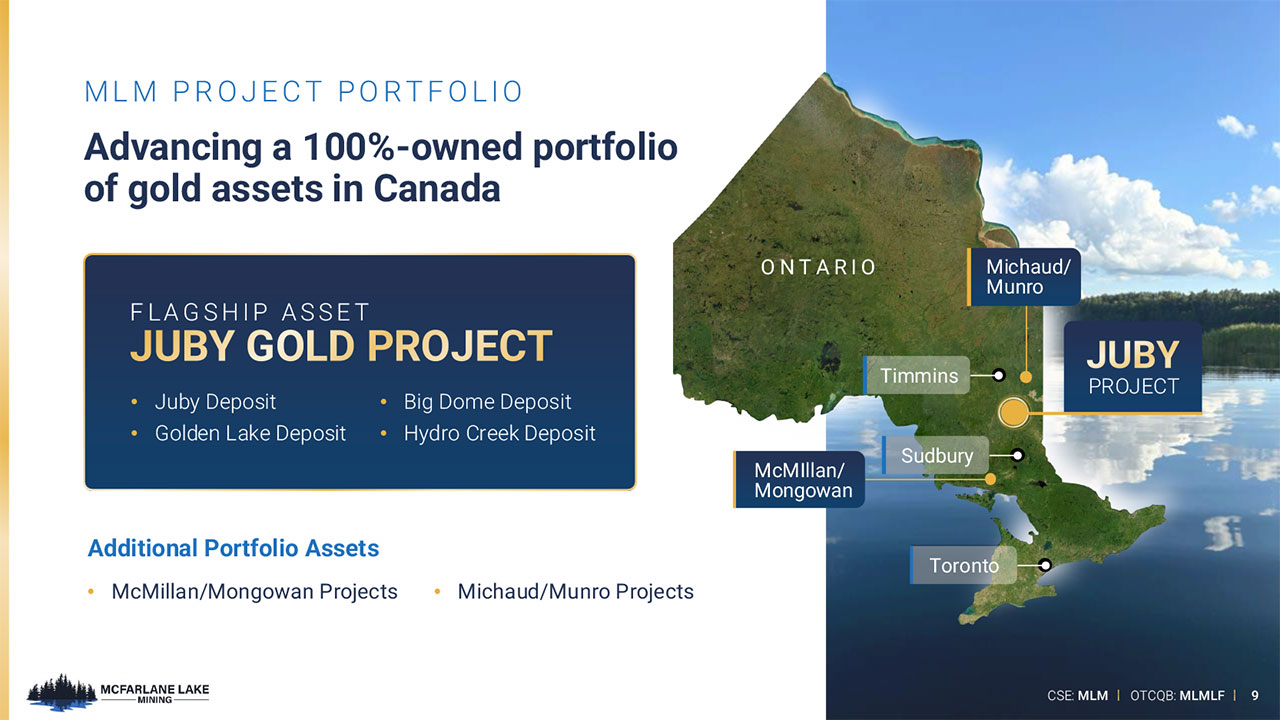
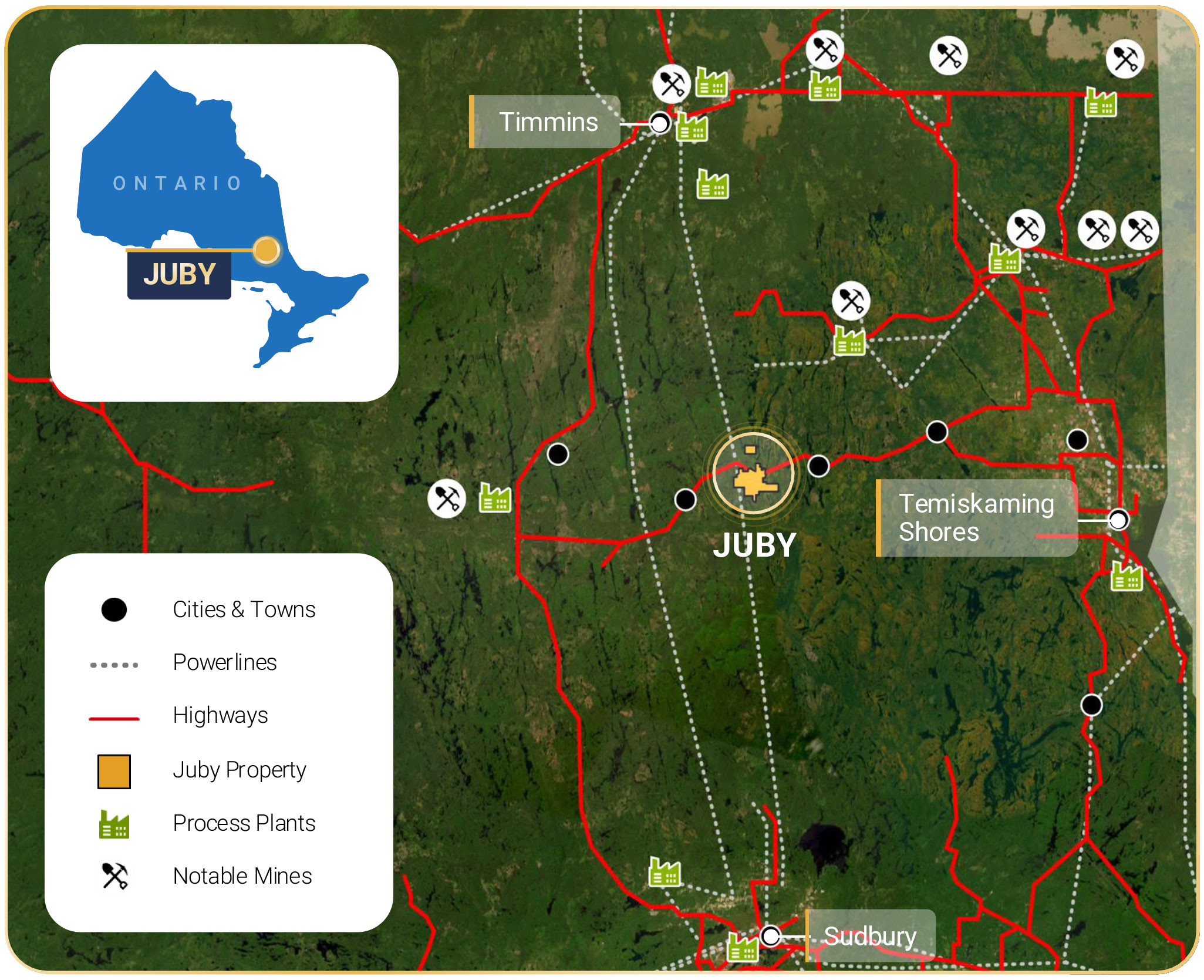
Located approximately 90 kilometers west of Temiskaming Shores in Ontario’s prolific Abitibi Greenstone Belt, the Juby Gold Project represents one of Ontario’s largest undeveloped gold deposits and is 100% owned by McFarlane.

Key Point for Investors: At a gold price of US$3,750/oz—below current market levels—the project’s resources (according to Canadian Mining Standards) expand to 1.20 million ounces Indicated and much higher when based on overall exploration and data estimates.

What Makes Juby Special?

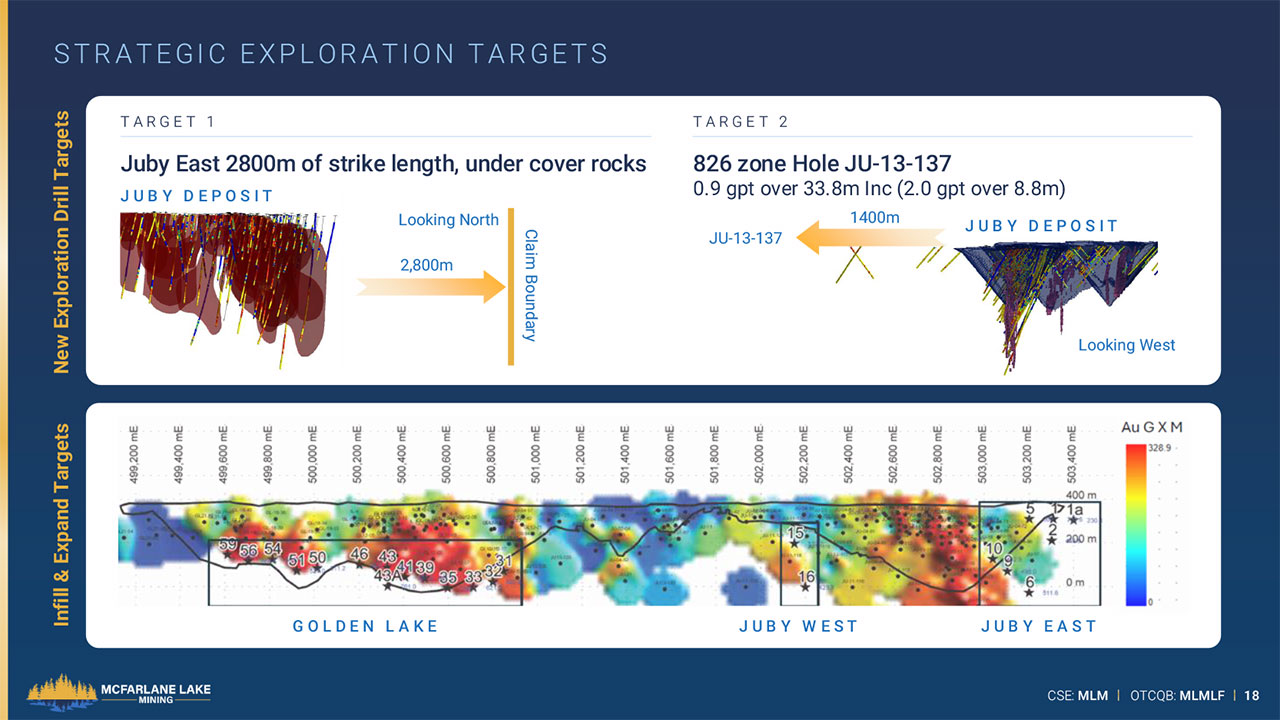
Multi-Zone Deposit System: The project encompasses four distinct gold resource areas—Juby, Golden Lake, Big Dome, and Hydro Creek—providing multiple exploration targets and resource expansion opportunities. Golden Lake and Juby zones have been identified as having the most significant potential to add ounces to the existing resource.

Investor Note: The mineral resource estimates have been prepared by the Company’s under Canadian mining standards, which differ significantly from the requirements of Subpart 1300 of Regulation S-K of the U.S. Securities and Exchange Commission (SEC).

Open Pit & Underground Potential: The resource estimate includes both open pit and underground components, calculated using cut-off grades of 0.25 g/t gold for open pit and 1.85 g/t gold for underground resources. This dual-scenario approach provides flexibility for future development scenarios.

Untapped Historic Drill Core: McFarlane’s exploration team has identified nearly 10,000 metres of historic drill core that was never sampled. Some 2,000 metres of priority core is currently being processed—representing potential resource additions without the cost of new drilling.

Independent Validation: The Mineral Resource Estimate was independently prepared by BBA E&C Inc., a highly respected Canadian engineering firm, in accordance with NI 43-101 standards and CIM Definition Standards (2014).

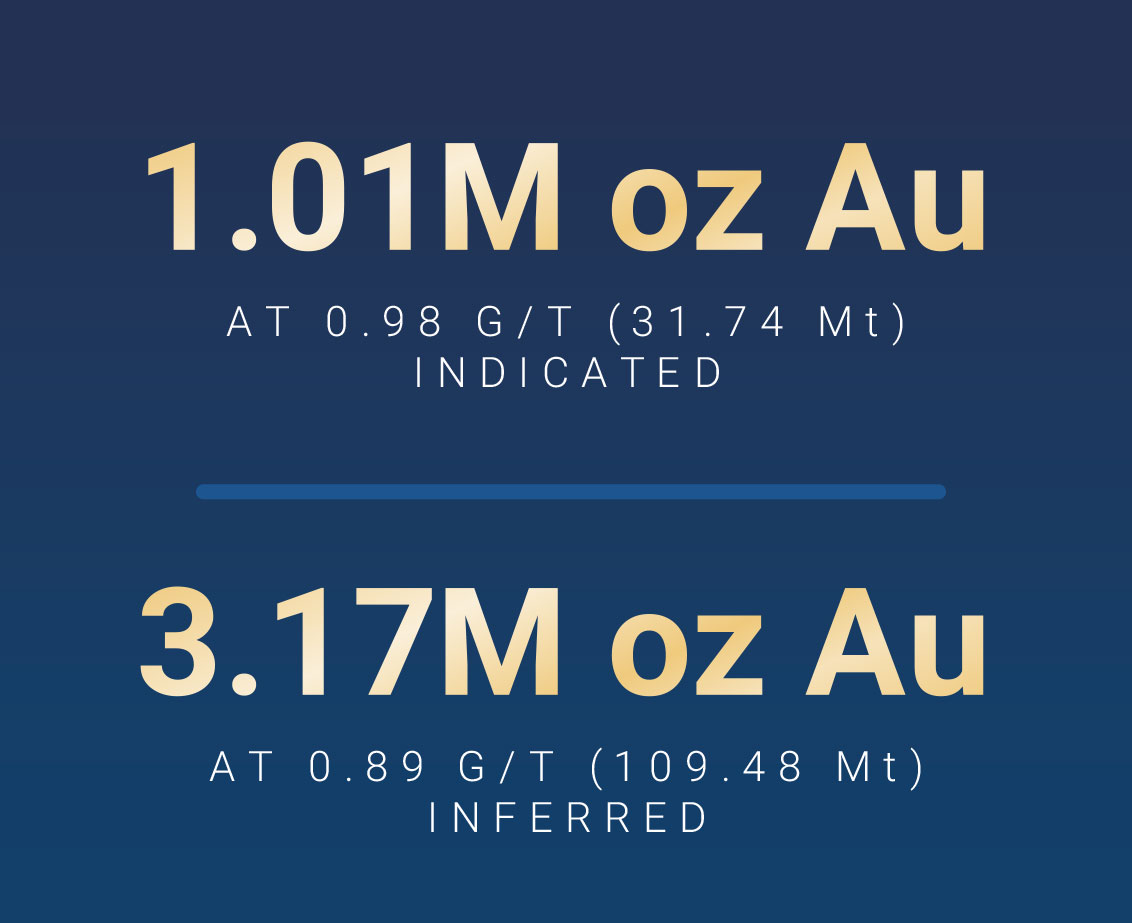
The project hosts a current NI 43-101 compliant Mineral Resource Estimate (effective September 29, 2025):

Category

Tonnes (M)

Grade (g/t Au)

Gold (M oz)

Indicated

31.74

0.98

1.01

TOTAL141.22

4.18

McFarlane Controlled Territory for Expansion

Proven High-Grade Property Ready for Modern Exploration

Historic Production, Untapped Potential

In an era when major gold producers are paying billions for deposits in remote, challenging jurisdictions, McFarlane Lake Mining controls a past-producing, high-grade gold mine just 70 kilometers from Sudbury—one of Canada’s most established mining centers.

The McMillan Mine isn’t a concept. It isn’t a target. It produced over 10,500 ounces of gold at a recovered grade of 5.5 g/t—exceptional by any standard—and it shut down not because the gold ran out, but because the 1930s economics couldn’t justify deeper development.

Today, with gold above $4,000/oz and modern exploration technology, the question isn’t whether there’s more gold at McMillan. The question is how much.

District-Scale Potential: The 28-Kilometer Huronian Gold Belt

McMillan isn’t an isolated occurrence. It sits within the Huronian Gold Belt, a 28-kilometer trend that has produced three significant gold mines:

  • Long Lake Mine: ~55,000 oz gold
  • Scadding Mine: ~30,000 oz gold
  • McMillan Mine: ~10,000 oz gold

Combined historic production exceeds 95,000 ounces—from operations that barely scratched the surface using 1930s technology. McFarlane Lake now controls a dominant land position along this belt.

The Geological Story: Why McMillan Works

Gold mineralization at McMillan is associated with extensive albitization developed along major fault systems, linked to 1.7-billion-year-old alkalic magmatism. This geological setting—fault-controlled, structurally hosted gold—is the same architecture that defines many of Canada’s largest gold deposits.

Two major fault systems converge on the property:

  • E-W trending House Lake Fault
  • NE trending Fox Lake Fault

Where faults intersect, gold concentrates. McMillan sits at that intersection—and multiple high-grade gold occurrences are focused along these structures.

The Bottom Line

The McMillan Mine produced high-grade gold for over a decade before shutting down in 1937. For the next 85+ years, it sat dormant—waiting for gold prices, technology, and a focused exploration team to unlock its full potential.

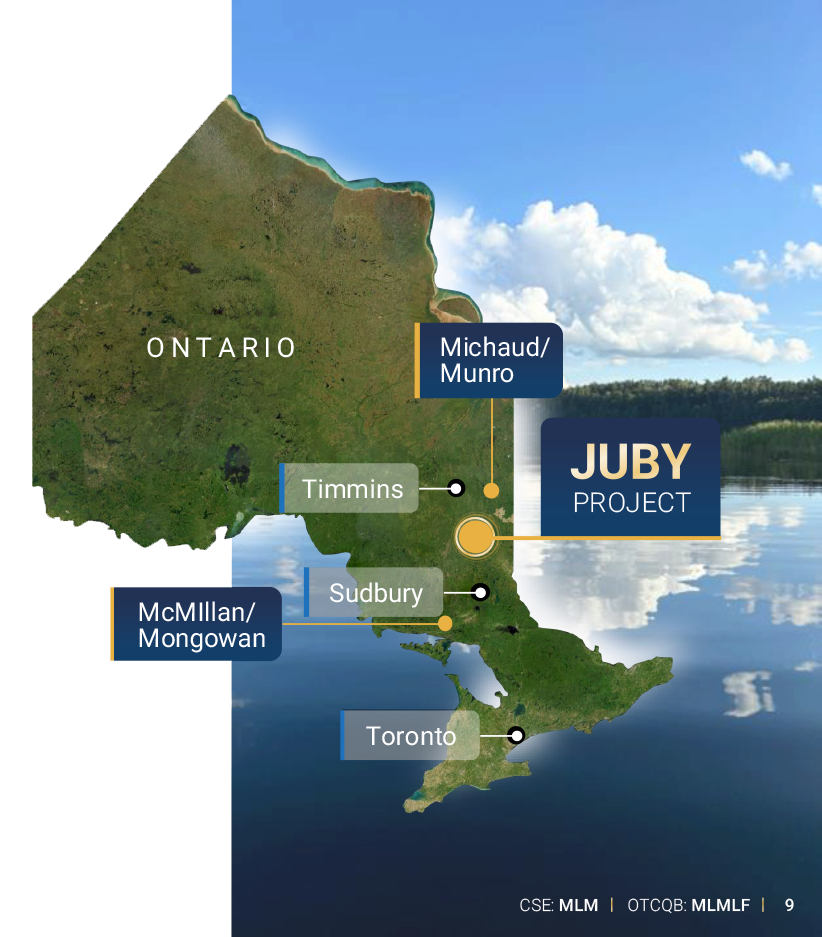
Michaud – Numerous historic shallow gold intersects. Approximately 4000m drilled since 1955, last drilled in 1995. Two well-known major fault systems to South and North of property (Destor-porcupine and pipestone faults). Property was family held for 50+ years until recently

Munro – Munro property is part of the prolific Kidd-Munro Lithostratigraphic assemblage within the Abitibi Greenstone belt. Ultramafic and Mafic Vocanic rocks which hosted 4 VMS producing mines, Kidd Creek mine 80km to the east and Potter, Potterdoal and Hedman mines to the immediate north and south of the property.

The Investment Case: Why Consider MLM?

Substantial Resource Base: 4.18 million ounces of gold (1.01M Indicated + 3.17M Inferred) at Juby alone, with potential for 5.42 million ounces at current gold prices.

Premier Location: Situated in the world’s most prolific gold belt, surrounded by major producers who are natural acquirers of advanced projects.

Experienced Management: Led by CEO Mark Trevisiol, P.Eng., the team has quickly advanced Juby from acquisition to NI 43-101 resource estimate, environmental studies initiation, and drill program planning.

Multiple Catalysts: Near-term news flow from drill results, historic core sampling, and ongoing project advancement activities.

Gold Price Leverage: Resource economics improve dramatically with gold prices—and most analysts expect gold to continue its ascent toward $5,000/oz.

Low Market Cap Entry: At approximately CAD $34 million market cap, investors gain exposure to a multi-million-ounce gold resource at a fraction of the value major producers have paid for similar assets in the Abitibi.

Near-Term Catalysts: Multiple Value Drivers

Diamond Drill Program (Awaiting Delivery): McFarlane is gearing up for a 10,000-to-15,000-metre drill program at Juby, targeting resource expansion at Golden Lake and Juby zones. Drilling results typically generate significant investor interest and can drive meaningful share price appreciation.

Historic Core Sampling Results (Weeks Away): Assay results from 2,000 metres of priority historic core are expected shortly—potential resource additions with no drilling cost.

Environmental Baseline Studies (Underway): McFarlane has engaged Pinchin Ltd. to complete comprehensive environmental studies—a critical step toward advancing permitting for eventual ore extraction. This proactive approach demonstrates management’s commitment to de-risking the project.

Ongoing Resource Growth: The company is actively working to expand the resource base through brownfield exploration around known mineralization. The multi-zone nature of Juby provides numerous targets for resource expansion.

McFARLANE INVESTOR HUB

Technical Report

Corporate Presentation

Financial Statement

Location Matters: The Abitibi Greenstone Belt Advantage

The Abitibi Greenstone Belt isn’t just any mining district—it’s arguably the most prolific gold-producing region on Earth. Stretching from Wawa, Ontario to Val-d’Or, Quebec, this 450 km by 150 km geological structure has delivered:

  • 200+ million ounces of gold produced since 1901
  • 100+ million ounces of gold remaining in known resources
  • 124 mines developed over the past century
  • 21 world-class deposits containing 3+ million ounces each

Major producers including Agnico Eagle, Alamos Gold, and Iamgold operate within the belt. McFarlane recently presented at the Northern Ontario Prospectors Conference alongside these industry giants—the same companies that actively acquire advanced exploration projects to feed their production pipelines.

Leadership Team

Mark Trevisiol, CEO

Over 30 years of experience in mining and metals processing. Former Senior Executive in Falconbridge and Xstrata Nickel. Managed operations in mining, milling, smelting and refining. Past CEO of two public mining companies, Crowlight Minerals and Silver Bear Resources.

Perry Dellelce, Director

Founder and managing partner of Wildeboer Dellelce LLP, one of Canada’s leading corporate finance and transactional law firms. Practicing in the areas of securities, corporate finance and mergers and acquisitions. Perry has been recognized by the Canadian Legal Expert as one of Canada’s leading practitioners in the areas of technology, transactions and global mining.

Brad Boland, CFO/Corporate Secretary

Founder and managing partner of Wildeboer Dellelce LLP, one of Canada’s leading corporate finance and transactional law firms. Practicing in the areas of securities, corporate finance and mergers and acquisitions. Perry has been recognized by the Canadian Legal Expert as one of Canada’s leading practitioners in the areas of technology, transactions and global mining.

Winston Whymark, Manager Exploration

Winston has worked in exploration for over 15 years, most of that time spent in gold exploration in management roles. He is manager of operations for Inventus Mining and was formerly Exploration Supervisor for Argonaut Gold.

Andrew McLellan, MSc, Senior Geologist

Andrew is a geologist with 15 years experience working in the Abitibi Greenstone belt focused on gold exploration. He has spent time working for Glencore, Trelawney Mining and Exploration, Baffinland Iron Mines, and various gold exploration companies.

DISCLOSURE FOR U.S. INVESTORS – FORWARD-LOOKING INFORMATION AND U.S. SEC REGULATION S-K 1300 (Disclosure by Registrants Engaged in Mining Operations)

  • The mineral resource estimates have been prepared by the Company under Canadian mining standards, which differ significantly from the requirements of Subpart 1300 of Regulation S-K as applicable to both the [US] Securities Act of 1933, as amended and the [US] Securities Exchange Act of 1934, as amended.
  • The Inferred category/data, according to US standards, inherently contains too high a level of uncertainty to be used for economic analysis.
  • None of the statements contained herein constitute guarantees of economic feasibility, profitability, or actual gold production.

Recent News

Must Read OTC Markets/SEC policy on stock promotion and investor protection

Disclaimer

EMC has been paid $100,000 by McFarlane Lake Mining, Limited. | Please read our full disclaimer

Subscribe to our newsletter for must read alerts.