
PowerBank Corporation

NASDAQ: SUUN | Cboe CA: SUNN | FSE: 103

PowerBank: Building Energy Independence

Real projects. Real capital. Real sovereignty.
PowerBank is deploying power generation + battery storage infrastructure immune to geopolitical disruption on earth and in orbit.

SYMBOL: NASDAQ: SUUN; Cboe CA: SUNN; FSE: 103

Disseminated on behalf of PowerBank Corporation

The world is running out of electrons. Artificial intelligence datacenters are devouring the grid, oil is surging past $100 a barrel, and the infrastructure built for the last century cannot power the next one. Into that gap steps PowerBank Corporation.

What began as a solar developer building community projects across Ontario and New York has evolved into something far more significant: a vertically integrated energy and power infrastructure company extending its reach from utility-scale solar farms and battery storage on Earth to satellite networks in low-Earth orbit. PowerBank is no longer simply a renewable energy firm. It is positioning itself at the intersection of collapsing fossil fuel economics, exploding AI power demand, and an orbital compute industry projected to exceed $700 billion, and that ambition reached a concrete milestone when the company’s collaboration with Orbit AI produced a successful satellite launch in December 2025.

Those who control the electrons will define the next era. PowerBank is building the infrastructure to deliver them.

Artificial intelligence doesn’t run on code. It runs on electricity, and the world is running out of it. Every major AI model trained today consumes as much power as a small city. The grid wasn’t built for this. The companies that solve the power problem won’t just profit from AI — they’ll own it.

Clean & Renewable Energy VS Oil-Fired Energy Generation

The Ever-Present Crisis

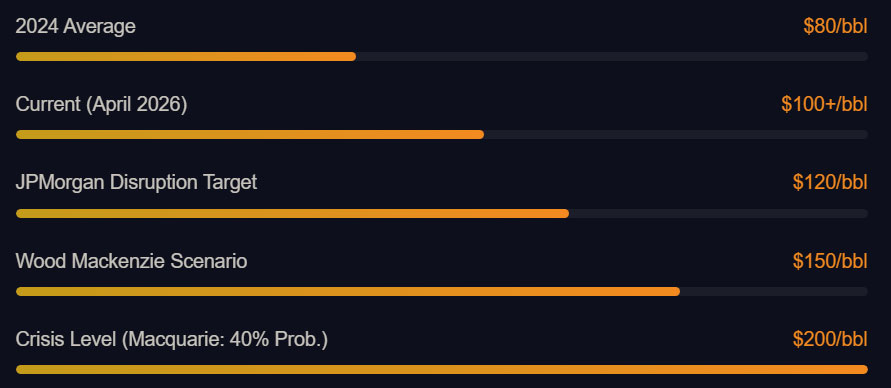
Market Conditions: $120 - $200 a Barrel Oil Is Just the Start.

With 20% of the world oil coming through the Strait of Hormuz – geopolitical conflicts are top of mind for most investors.

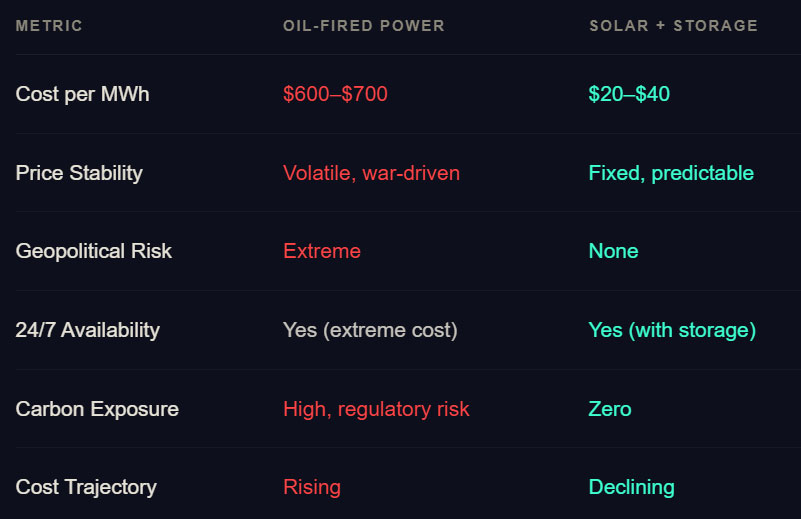
Oil has already shattered $100 a barrel. JPMorgan projects $120 under sustained Strait of Hormuz disruption. At $200, oil-fired electricity approaches $700 per megawatt-hour. Solar and battery storage delivers that same megawatt-hour for $20 to $40. That’s not a marginal advantage, it’s economic gravity.

Analysts at some of the world’s most respected institutions are warning that $200 oil is no longer far-fetched. Wood Mackenzie says it is “not outside the realms of possibility.” Macquarie assigns a 40 percent probability to the scenario. An Oxford energy expert has called it “perfectly possible.” 

Maintenance worker in a yellow safety jacket and hard hat inspecting a solar panel array outdoors at sunrise/sunset.

AI Datacenters Need Electrons. PowerBank Delivers.

As AI devours the grid and oil approaches $200 a barrel, one NASDAQ-listed company is quietly building the infrastructure that powers the next century, from Earth to orbit.

Aerial view of a solar farm with numerous blue solar panels arranged in parallel rows on green fields and a road nearby.

Generation

On-Site Power Storage

Row of server racks with tangled cables and blinking green and amber status LEDs in a data center front panel

Powering AI

Solving 24/7 Demand

Row of solar panels tilted on metal supports in a grassy field under a bright blue, partly cloudy sky (solar farm).

Scalable

Clean. Fast. Modular.

The Energy Sovereignty Imperative | Solar vs Oil Economy

While oil-dependent energy systems remain vulnerable to geopolitical conflicts, supply chain disruptions, and foreign influence, solar generation offers true energy independence, that is largely immune to shipping routes, OPEC decisions, and international tensions.

Data centers and modern societies are dependent on consistent energy supplies, and interruptions caused by geopolitical instability could cause catastrophic impacts and strategic uncertainty, making solar an equalizer as power demands rise.

Solar's Geopolitical Advantages

  • No Transportation Required: Energy generated where consumed, eliminating shipping vulnerabilities and chokepoint risks

  • Domestically Sourced: Sunlight cannot be embargoed, sanctioned, or withheld by foreign governments

  • Decentralized Production: Distributed generation across multiple sites prevents single-point-of-failure disruptions

  • Price Stability: Solar energy costs unaffected by foreign conflicts, OPEC decisions, or international trade disputes

  • Infrastructure Resilience: Thousands of distributed solar sites are far harder to disrupt than concentrated oil facilities and shipping routes

  • Energy Sovereignty: Nations control their own energy destiny independent of foreign suppliers

Oil's Geopolitical Vulnerabilities

  • Strait of Hormuz Risk: 20% of global petroleum passes through this 21-mile-wide chokepoint, vulnerable to closure during Middle East conflicts

  • Shipping Route Dependencies: Global oil trade relies on maritime corridors subject to piracy, blockades, and military conflicts

  • OPEC Production Controls: 13-nation cartel influences global prices through coordinated supply restrictions

  • Regime Change Volatility: Political instability in oil-producing nations creates immediate supply disruptions and price spikes

  • Sanctions & Trade Wars: International disputes routinely weaponize energy supplies as geopolitical leverage

  • Infrastructure Sabotage: Pipelines, refineries, and export terminals are high-value military targets during conflicts

“The biggest issue we are now having is not a compute glut, but it’s the power and…the ability to get the builds done fast enough close to power,” Microsoft CEO Satya Nadella acknowledged on a recent podcast with OpenAI chief Sam Altman.”

— Satya Nadella, CEO, Microsoft

AI Compute Growth / Year
0 %
New US Power — Solar & Storage
0 %
AI Infrastructure Needed
$ 0 T+
2025 Solar Installs — Red States
0 %

Solar Vs Oil Comparison by the Numbers

0
GW
Development Pipeline
0
%
OPEC Dependencies
0
%
Shipping Chokepoints
0
%
Local Fuel Source

Business Model Pipeline

PowerBank already has commercial traction and institutional-grade partners:

  • $100 M announced financing with CIM Group to support new power supply
  • $22.8 M contract with Qcells to develop two solar projects
  • $41 M contract with Honeywell International
  • Partnership with Fiera Real Estate for energy-resilient portfolios
  • 20MW of solar and battery contracts secured with government entity
  • $25.8 M renewable financing facility with RBC Bank

Each project establishes a repeatable model that can scale into PowerBank’s one gigawatt development pipelines.

New Revenue Stream | Faster To Market

PowerBank Signs LOI with Nodiac.ai to Co-Locate Modular Data Centers at Solar Sites

PowerBank has signed a Letter of Intent with Nodiac.ai, a distributed data center company whose “Speed-to-Power” platform is designed to deploy modular, containerized AI compute infrastructure directly at existing renewable energy sites, potentially bringing inference capacity online in months rather than years. The LOI provides a framework for screening PowerBank’s portfolio of solar and BESS sites across North America for co-location suitability. Nodiac’s founding team brings experience from Greenbacker, Acciona Energy, and Invenergy, with over $26 billion in energy projects developed globally.

$29B→$80B
Modular Data Center Market by 2030
1–15 MW
Scalable Modular Units per Site
100+ MW
PowerBank's Built Capacity Available

“The accelerating demand for AI compute infrastructure represents a defining opportunity for renewable energy developers — and an urgent challenge for the planet,” said Dr. Richard Lu, Chief Executive Officer of PowerBank Corporation. “Our planned transaction with Nodiac reflects our conviction that the digital economy must be built on a clean energy foundation. With the potential to co-locate data center infrastructure directly at our renewable energy sites, we are not only providing an opportunity for accelerating speed to power for the AI industry — we are intending to ensure that the infrastructure powering tomorrow’s economy is sustainable, distributed, and resilient.”

Read Release

Power Generation Has A National Security Impact

The Electron Gap

Last year, China added 430 gigawatts of new power generation capacity. The United States added 53. That is an 8-to-1 deficit in the single resource that will determine AI supremacy and national security for decades.

China | 2025 New Capacity

Added In A Single Year
0 GW

U.S. | 2025 New Capacity

Added In A Single Year
0 GW
Rows of server racks in a data center with green indicator lights.

OpenAI has warned this “electron gap” threatens America’s ability to lead in AI. PowerBank is part of the solution.

The Strategic Energy Equation

Solar Power Generation (PowerBank Model)

  • Availability: Solar energy can be generated on Earth and in orbit, without being locked into one geographic region

  • Energy Source: Sunlight is free, abundant, locally sourced

  • Vulnerability: None to geopolitical events, shipping disruptions, or foreign conflicts

  • Price Volatility: Zero, no solar energy costs spikes at solar farm installations

  • Supply Reliability: Predictable, consistent, independent of any foreign nation or shipping route

Oil-Dependent Power Generation

  • Energy Source: Many economies depend upon imported petroleum transported 5,000+ miles through politically unstable regions

  • Vulnerability: Strait of Hormuz closure, regional war, OPEC embargo, tanker attacks, pipeline sabotage

    Price Volatility: Subject to foreign policy decisions, cartel pricing, conflict premiums

  • Supply Reliability: Dependent on continuous maritime shipping and geopolitical stability

PowerBank’s Solution | Solar. Storage. AI. Orbit.

PowerBank operates across four integrated infrastructure layers, making it one of the only NASDAQ-listed companies to connect terrestrial renewable energy directly to the orbital economy.

Solar Generation

Utility-scale solar producing electricity at a fraction of fossil fuel costs, with zero exposure to geopolitical disruption or volatile fuel markets. Active pipeline across New York, Ontario, Pennsylvania, and Nova Scotia.

$20–40
Per MWh (vs $600+ oil-fired)

Battery Storage

Round-the-clock power delivery through co-located BESS systems. The intermittency argument that once slowed solar adoption has been neutralized. 11 MWh of storage procured in the active pipeline.

24/7
Dispatchable Clean Power

AI Compute + Orbit

Modular AI compute deployed at energy generation sites via Intellistake AI agents, bypassing grid interconnection bottlenecks entirely. A collaboration with Orbit AI extends this to low-Earth orbit.

$700B
Projected Orbital Economy

AI Compute Is Moving Into Orbit.

As AI systems grow, the demands on Earth’s power grid have grown steadily. Training a frontier model can consume as much electricity as a small town. Water-cooled data centers increasingly push up against environmental limits. Nations are beginning to restrict new builds due to local grid strain.

This is precisely why global technology leaders now see orbit as the inevitable next step.

PowerBank's collaboration with Orbit AI connects its terrestrial energy expertise to the orbital economy, a market projected to exceed $700 billion over the next decade.

“We will be able to beat the cost of terrestrial data centres in space in the next couple of decades. We have solar power there, 24/7 – no clouds, no rain, no weather.”

— Jeff Bezos, Founder, Amazon

Projections:

  • $39.1B | In-Orbit Data Centers by 2035
  • $615B | Global Satellite Market by 2032
  • 11,700+ | Active Satellites in Orbit Today
  • 260+ | Rocket Launches Projected 2025

What Orbit Offers That Earth Cannot

  • Continuous 24/7 solar power, no weather, no clouds, no night cycle
  • Natural vacuum cooling eliminates up to 40% of terrestrial data center energy cost
  • 5–10x the solar energy intensity of Earth-based solar farms
  • Decentralized orbital nodes resistant to grid failures and geopolitical disruption
  • Low-latency LEO global coverage for AI compute at the point of demand

PowerBank’s Vision: A Unified Terrestrial–Orbital Energy & Compute Network

PowerBank’s evolution into this domain has been methodical.
Orbit AIis building three major systems:

  1. DeStarlink – A decentralized LEO satellite constellation designed to complement , not compete with, traditional networks by adding a Web3-native communication layer for global devices, enterprises and sovereign clients.

  2. DeStarAI – A series of solar-powered orbital AI data centers, equipped with passive cooling systems that reduce energy use by orders of magnitude.

  3. The Orbital Cloud – A blockchain-integrated platform enabling secure compute, data verification, and financial settlement directly in orbit, independent of Earth’s terrestrial infrastructure. Through its collaboration with Orbit AI, PowerBank intends to contribute advanced solar energy systems and adaptive thermal control solutions, reflecting its broader shift toward digital asset, data center, and RWA (Real World Asset) infrastructure, where solar power supports digital infrastructure deployments and high-growth AI markets. PowerBank’s contribution focuses on solar power and adaptive thermal technologies essential to future satellite’s “Execution Layer.”

The Market: A $700B Orbital Economy

The global shift into space infrastructure is backed by extraordinary forecasts:

  • Orbital Infrastructure: USD $13.5B in 2024 → $21.3B by 2029 (CAGR ~9.6%)
  • Global Satellite Market: projected USD $615B by 2032
  • In-Orbit Data Centers: USD $1.77B in 2029 → $39.1B by 2035
  • Satellite Data Services: ~$12.16B in 2024 → ~$55.24B by 2034 (CAGR ~16.3%)

THE TAKEAWAY IS SIMPLE:
What the internet was in 1995, uncharted, chaotic, and full of first-mover gold…Orbit could become that new frontier.

And PowerBank (NASDAQ: SUUN) is gaining exposure at the earliest stage of this generational shift.

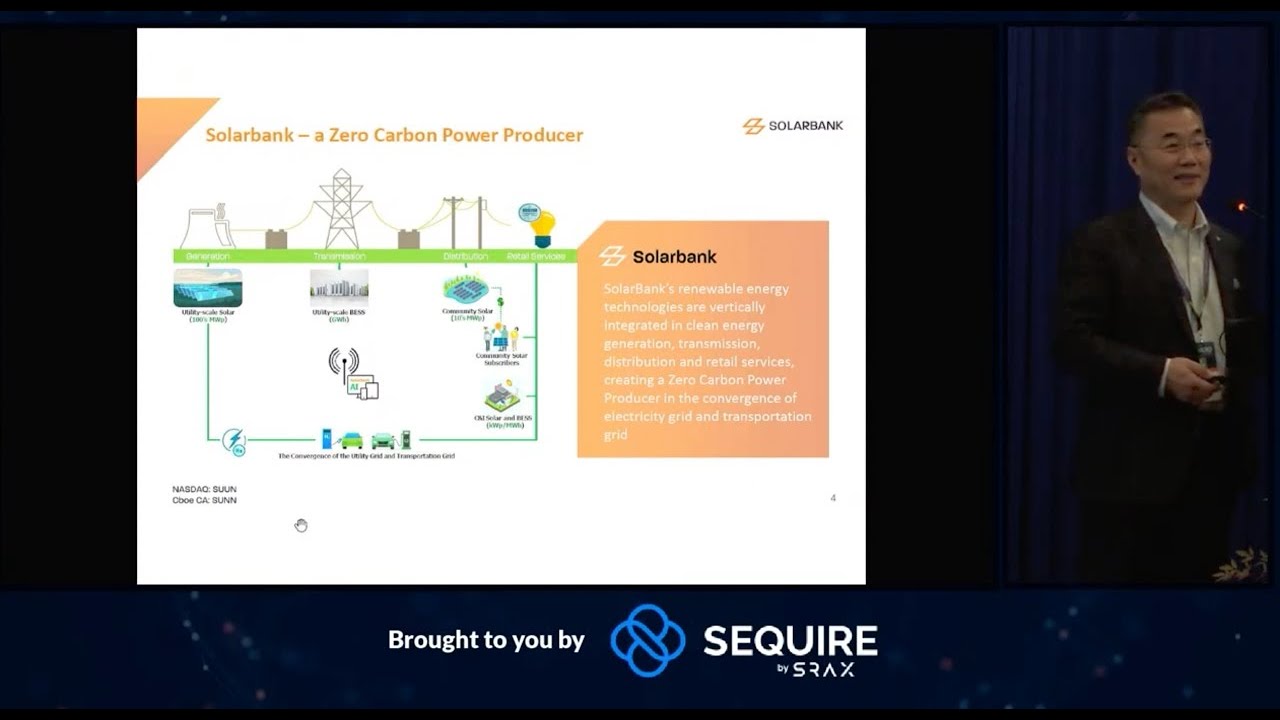
A View From PowerBank Itself

Richard Lu, CEO of PowerBank, frames the company’s mission in terms of generational impact:

“The next frontier of human innovation isn’t just in space exploration, it’s in building the infrastructure of tomorrow above the Earth,” said Dr. Richard Lu, CEO of PowerBank. “The combined markets for orbital satellites, in-orbit data centers, blockchain verification, and solar-powered digital infrastructure are projected to exceed $700 billion over the next decade. By integrating solar energy with orbital computing, PowerBank is helping create a globally sovereign, AI-enabled digital layer in space, which is a system that can help power finance, communications, and critical infrastructure.”

It is a rare statement in today’s corporate landscape: part engineering, part philosophy.

Smart Money Is Watching.

Recognized institutional investors have taken positions in SUUN, including names from the world's largest financial institutions.

Goldman Sachs Group
Institutional Holder
Citadel Advisors
33.68K Shares
Royal Bank of Canada
Financing Partner + Holder
PNC Financial Services
Institutional Holder
UBS Wealth Management
Institutional Holder

Featured Institutional Share Holders:

  • Goldman Sachs Group Inc.
  • UBS Wealth Management
HolderSharesDate Reported% OutValue
Citadel Advisors LLC33.68kSep 30, 20250.09%54,249
NWF Advisory Services Inc30kSep 30, 20250.08%48,317
Osaic Holdings Inc.30kSep 30, 20250.08%48,317
Parallel Advisors, LLC27.42kSep 30, 20250.07%44,165
Goldman Sachs Group Inc19.06kSep 30, 20250.05%30,693
Frisch Financial Group, Inc.15kSep 30, 20250.04%24,158
Xtx Topco Ltd16.42kSep 30, 20250.04%26,449
Royal Bank of Canada13.9kSep 30, 20250.04%22,385
Hardin Capital Partners, LLC10kSep 30, 20250.03%16,105
PNC Financial Services Group, Inc.5kSep 30, 20250.01%8,052

Spotlight News

PowerBank Investor Presentation

PowerBank Investor Resources

PowerBank One Sheet

PowerBank Nasdaq Statement

POWERBANK Videos

PowerBank Industry Expertise & Leadership

Since inception, PowerBank approaches each project as a long-term partnership, differentiating the company from developers that exit projects at NTP or COD. They create value for project equity holders by designing, constructing, and operating the solar power plants to maximize long-term performance and returns, rather than maximizing up-front development fees.

While most competitors focus on only a single segment of the renewable energy value chain, PowerBank’s expertise spans every stage of the process, making them highly competitive on cost management and volume of business. Their in-house development, permitting, engineering and construction workflow enables them to finish turnkey solar projects in an efficient and timely manner.

Photo of Richard Lu

Dr. Richard Lu

MD, MSc., MHSc., MBA, CEO and Director

Dr. Richard Lu

Dr. Lu has more than 25 years of global energy experience developing and implementing growth strategies for organizations in North America, Europe and Asia. He leads a team of established and trusted developers, engineers, asset operators, and managers in the clean and renewable energy space in Canada and the US.
Photo of Sam Sun

Sam Sun

MBA Chief Financial Officer

Sam Sun

Mr. Sun is a Chartered Professional Accountant in Canada with more than 15 years of experience in corporate finance, accounting and internal control. He has been the head of finance or finance director at various Canadian, U.S. and Chinese public and private companies in the cleantech, manufacturing and mining sectors.
Image of Andrew van Doorn, PE

Andrew van Doorn

PE, President and COO

Andrew van Doorn

Mr. van Doorn has over 28 years of leadership experience in Engineering and Construction in the Renewable Energy and Utility sectors, with over 200MW of solar projects completed. As former Chairman of the Canadian Solar Industries Association (CANSIA), Mr. van Doorn is an expert in the operations of solar photovoltaic systems.
Photo of Richard Lu

Dr. Richard Lu

MD, MSc., MHSc., MBA, CEO and Director

Dr. Richard Lu

Dr. Lu has more than 25 years of global energy experience developing and implementing growth strategies for organizations in North America, Europe and Asia. He leads a team of established and trusted developers, engineers, asset operators, and managers in the clean and renewable energy space in Canada and the US.
Photo of Sam Sun

Sam Sun

MBA Chief Financial Officer

Sam Sun

Mr. Sun is a Chartered Professional Accountant in Canada with more than 15 years of experience in corporate finance, accounting and internal control. He has been the head of finance or finance director at various Canadian, U.S. and Chinese public and private companies in the cleantech, manufacturing and mining sectors.
Image of Andrew van Doorn, PE

Andrew van Doorn

PE Chief Operating Officer

Andrew van Doorn

Mr. van Doorn has over 28 years of leadership experience in Engineering and Construction in the Renewable Energy and Utility sectors, with over 200MW of solar projects completed. As former Chairman of the Canadian Solar Industries Association (CANSIA), Mr. van Doorn is an expert in the operations of solar photovoltaic systems.
Image of Matt Wayrynen.

Matt Wayrynen

Executive Chairman, Director

Matt Wayrynen

Mr. Wayrynen led Solar Flow-Through Funds since its inception in 2012, playing a key role in raising over $150 million in project financing and navigating the company's regulatory, financial, and managerial challenges prior to its acquisition by PowerBank in 2024.
Image of Olen Aasen, J.D.

Olen Aasen

J.D., General Counsel

Olen Aasen

Mr. Aasen is an executive and corporate and securities lawyer with more than 16 years of experience in corporate, securities, mining and regulatory matters. He has been the Corporate Secretary, General Counsel or Vice President, Legal at various Canadian and U.S.- listed companies.
Image of Paul Pasalic, J.D.

Paul Pasalic

J.D. Director

Paul Pasalic

Mr. Pasalic is a private equity professional and a corporate lawyer with more than 15 years of experience in corporate, securities and regulatory matters. Mr. Pasalic has advised on a diverse array of complex multi-jurisdictional transactions across various industries and across the capital structure.
Image of Matt Wayrynen.

Matt Wayrynen

Executive Chairman, Director

Matt Wayrynen

Mr. Wayrynen led Solar Flow-Through Funds since its inception in 2012, playing a key role in raising over $150 million in project financing and navigating the company's regulatory, financial, and managerial challenges prior to its acquisition by PowerBank in 2024.
Image of Olen Aasen, J.D.

Olen Aasen

J.D., Director

Olen Aasen

Mr. Aasen is an executive and corporate and securities lawyer with more than 16 years of experience in corporate, securities, mining and regulatory matters. He has been the Corporate Secretary, General Counsel or Vice President, Legal at various Canadian and U.S.- listed companies.
Image of Paul Sparkes

Paul Sparkes

Director

Paul Sparkes

Mr. Sparkes is an entrepreneur with over 25 years of experience in media, finance, capital markets and Canada's political arena. He spent a decade in the broadcast and media industry as CTVglobemedia's Executive Vice President, Corporate Affairs.
Image of Chelsea Nickles.

Chelsea Nickles

Director

Chelsea Nickles

Ms. Nickles is a renewable energy professional with more than 20 years of experience contributing to a net zero world. For nearly the past decade, Ms. Nickles has been focusing on developing offshore wind projects in multiple jurisdictions with Ørsted, the global leader in offshore wind.
Image of Paul Pasalic, J.D.

Paul Pasalic

J.D. Director

Paul Pasalic

Mr. Pasalic is a private equity professional and a corporate lawyer with more than 15 years of experience in corporate, securities and regulatory matters. Mr. Pasalic has advised on a diverse array of complex multi-jurisdictional transactions across various industries and across the capital structure.
Image of Paul Sparkes

Paul Sparkes

Director

Paul Sparkes

Mr. Sparkes is an entrepreneur with over 25 years of experience in media, finance, capital markets and Canada's political arena. He spent a decade in the broadcast and media industry as CTVglobemedia's Executive Vice President, Corporate Affairs.
Image of Chelsea Nickles.

Chelsea Nickles

Director

Chelsea Nickles

Ms. Nickles is a renewable energy professional with more than 20 years of experience contributing to a net zero world. For nearly the past decade, Ms. Nickles has been focusing on developing offshore wind projects in multiple jurisdictions with Ørsted, the global leader in offshore wind.

Recent News

This news release contains forward-looking statements and forward-looking information ‎within the meaning of Canadian securities legislation (collectively, “forward-looking ‎statements”) that relate to the Company’s current expectations and views of future events. ‎Any statements that express, or involve discussions as to, expectations, beliefs, plans, ‎objectives, assumptions or future events or performance (often, but not always, through the ‎use of words or phrases such as “will likely result”, “are expected to”, “expects”, “will ‎continue”, “is anticipated”, “anticipates”, “believes”, “estimated”, “intends”, “plans”, “forecast”, ‎‎”projection”, “strategy”, “objective” and “outlook”) are not historical facts and may be ‎forward-looking statements and may involve estimates, assumptions and uncertainties ‎which could cause actual results or outcomes to differ materially from those expressed in ‎such forward-looking statements. In particular and without limitation, this news release ‎contains forward-looking statements pertaining to the Company’s expectations regarding industry trends and overall market growth; the details of the collaboration with Orbit AI and its expected benefits; the Company’s contributions towards the collaboration with Orbit AI; the timelines for Orbit AI’s operations the Company’s growth strategies,  and the size of the Company’s development pipeline. No assurance ‎can be given that these expectations will prove to be correct and such forward-looking ‎statements included in this news release should not be unduly relied upon. These ‎statements speak only as of the date of this news release.‎


Forward-looking statements are based on certain assumptions and analyses made by the Company in light of the experience and perception of historical trends, current conditions and expected future developments and other factors it believes are appropriate, and are subject to risks and uncertainties. In making the forward looking statements included in this news release, the Company has made various material assumptions, including but not limited to: the Company is able to raise sufficient financing to complete the announced investment into Orbit AI; obtaining the necessary regulatory approvals; that regulatory requirements will be maintained; general business and economic conditions; the Company’s ability to successfully execute its plans and intentions; the availability of financing on reasonable terms; the Company’s ability to attract and retain skilled staff; market competition; the products and services offered by the Company’s competitors; that the Company’s current good relationships with its service providers and other third parties will be maintained; and government subsidies and funding for renewable energy will continue as currently contemplated. Although the Company believes that the assumptions underlying these statements are reasonable, they may prove to be incorrect, and the Company cannot assure that actual results will be consistent with these forward-looking statements. Given these risks, uncertainties and assumptions, investors should not place undue reliance on these forward-looking statements.


Whether actual results, performance or achievements will conform to the Company’s expectations and predictions is subject to a number of known and unknown risks, uncertainties, assumptions and other factors, including those listed under “Forward-‎Looking Statements” and “Risk ‎Factors” in the Company’s most recently completed Annual Information Form, and other public filings of the Company, which include: the Company fails to raise sufficient financing to complete the announced investment into Orbit AI; Orbit AI is unable to raise sufficient financing to complete its launch of satellites on the timelines proposed or at all; technical risks associated with Orbit AI’s planned operations; the Company may be adversely affected by volatile solar power market and industry conditions; the execution of the Company’s growth strategy depends upon the continued availability of third-party financing arrangements; the Company’s future success depends partly on its ability to expand the pipeline of its energy business in several key markets; governments may revise, reduce or eliminate incentives and policy support schemes for solar and battery storage power; general global economic conditions may have an adverse impact on our operating performance and results of operations; the Company’s project development and construction activities may not be successful; developing and operating solar Project exposes the Company to various risks; the Company faces a number of risks involving Power Purchase Agreements (“PPAs”) and project-level financing arrangements; any changes to the laws, regulations and policies that the Company is subject to may present technical, regulatory and economic barriers to the purchase and use of solar power; the markets in which the Company competes are highly competitive and evolving quickly; an anti-circumvention investigation could adversely affect the Company by potentially raising the prices of key supplies for the construction of solar power projects; foreign exchange rate fluctuations; a change in the Company’s effective tax rate can have a significant adverse impact on its business; seasonal variations in demand linked to construction cycles and weather conditions may influence the Company’s results of operations; the Company may be unable to generate sufficient cash flows or have access to external financing; the Company may incur substantial additional indebtedness in the future; the Company is subject to risks from supply chain issues; risks related to inflation and tariffs; unexpected warranty expenses that may not be adequately covered by the Company’s insurance policies; if the Company is unable to attract and retain key personnel, it may not be able to compete effectively in the renewable energy market; there are a limited number of purchasers of utility-scale quantities of electricity; compliance with environmental laws and regulations can be expensive; corporate responsibility may adversely impose additional costs; the future impact of any global pandemic on the Company is unknown at this time; the Company has limited insurance coverage; the Company will be reliant on information technology systems and may be subject to damaging cyberattacks; the Company may become subject to litigation; there is no guarantee on how the Company will use its available funds; the Company will continue to sell securities for cash to fund operations, capital expansion, mergers and acquisitions that will dilute the current shareholders; and future dilution as a result of financings.


The Company undertakes no obligation to update or revise any ‎forward-looking statements, whether as a result of new information, future events or ‎otherwise, except as may be required by law. New factors emerge from time to time, and it ‎is not possible for the Company to predict all of them, or assess the impact of each such ‎factor or the extent to which any factor, or combination of factors, may cause results to ‎differ materially from those contained in any forward-looking statement. Any forward-‎looking statements contained in this news release are expressly qualified in their entirety by ‎this cautionary statement.‎

Spotlight News

PowerBank Corporation Disclaimer

There are several risks associated with the development of the projects disclosed in this report. The development of any project is subject to receipt of a community solar contract, receipt of required permits, the availability of third-party financing arrangements for the Company and the risks associated with the construction of a solar power project. In addition, governments may revise, reduce or eliminate incentives and policy support schemes for solar power, which could result in future projects no longer being economic.

This report contains forward-looking statements and forward-looking information ‎within the meaning of Canadian securities legislation (collectively, “forward-looking ‎statements”) that relate to the Company’s current expectations and views of future events. ‎Any statements that express, or involve discussions as to, expectations, beliefs, plans, ‎objectives, assumptions or future events or performance (often, but not always, through the ‎use of words or phrases such as “will likely result”, “are expected to”, “expects”, “will ‎continue”, “is anticipated”, “anticipates”, “believes”, “estimated”, “intends”, “plans”, “forecast”, ‎‎”projection”, “strategy”, “objective” and “outlook”) are not historical facts and may be ‎forward-looking statements and may involve estimates, assumptions and uncertainties ‎which could cause actual results or outcomes to differ materially from those expressed in ‎such forward-looking statements. In particular and without limitation, this report ‎contains forward-looking statements pertaining to the Company’s expectations regarding its industry trends and overall market growth; the Company’s growth strategies the expected energy production from the solar power projects mentioned in this report; the timeline for construction; market outlook for solar energy;  the receipt of interconnection approval, permits and financing to be able to construct the Projects; the receipt of incentives for the Projects; and the size of the Company’s development pipeline. No assurance ‎can be given that these expectations will prove to be correct and such forward-looking ‎statements included in this report should not be unduly relied upon. These ‎statements speak only as of the date of this report.‎

Forward-looking statements are based on certain assumptions and analyses made by the Company in light of the experience and perception of historical trends, current conditions and expected future developments and other factors it believes are appropriate, and are subject to risks and uncertainties. In making the forward looking statements included in this report, the Company has made various material assumptions, including but not limited to: obtaining the necessary regulatory approvals; that regulatory requirements will be maintained; general business and economic conditions; the execution of definitive documentation for the CIM transaction; the satisfaction of all conditions precedent for the CIM transaction; the Company’s ability to successfully execute its plans and intentions; the availability of financing on reasonable terms; the Company’s ability to attract and retain skilled staff; market competition; the products and services offered by the Company’s competitors; that the Company’s current good relationships with its service providers and other third parties will be maintained; and government subsidies and funding for renewable energy will continue as currently contemplated. Although the Company believes that the assumptions underlying these statements are reasonable, they may prove to be incorrect, and the Company cannot assure that actual results will be consistent with these forward-looking statements. Given these risks, uncertainties and assumptions, investors should not place undue reliance on these forward-looking statements.

Whether actual results, performance or achievements will conform to the Company’s expectations and predictions is subject to a number of known and unknown risks, uncertainties, assumptions and other factors, including those listed under “Forward-‎Looking Statements” and “Risk ‎Factors” in the Company’s most recently completed Annual Information Form, and other public filings of the Company, which include: the Company may be adversely affected by volatile solar power market and industry conditions; the failure to execute definitive documentation for the CIM transaction; the failure to satisfy all conditions precedent for the CIM transaction; the execution of the Company’s growth strategy depends upon the continued availability of third-party financing arrangements; the Company’s future success depends partly on its ability to expand the pipeline of its energy business in several key markets; governments may revise, reduce or eliminate incentives and policy support schemes for solar and battery storage power; general global economic conditions may have an adverse impact on our operating performance and results of operations; the Company’s project development and construction activities may not be successful; developing and operating solar projects exposes the Company to various risks; the Company faces a number of risks involving Power Purchase Agreements (“PPAs”) and project-level financing arrangements; any changes to the laws, regulations and policies that the Company is subject to may present technical, regulatory and economic barriers to the purchase and use of solar power; the markets in which the Company competes are highly competitive and evolving quickly; an anti-circumvention investigation could adversely affect the Company by potentially raising the prices of key supplies for the construction of solar power projects; foreign exchange rate fluctuations; a change in the Company’s effective tax rate can have a significant adverse impact on its business; seasonal variations in demand linked to construction cycles and weather conditions may influence the Company’s results of operations; the Company may be unable to generate sufficient cash flows or have access to external financing; the Company may incur substantial additional indebtedness in the future; the Company is subject to risks from supply chain issues; risks related to inflation and tariffs; unexpected warranty expenses that may not be adequately covered by the Company’s insurance policies; if the Company is unable to attract and retain key personnel, it may not be able to compete effectively in the renewable energy market; there are a limited number of purchasers of utility-scale quantities of electricity; compliance with environmental laws and regulations can be expensive; corporate responsibility may adversely impose additional costs; the future impact of any global pandemic on the Company is unknown at this time; the Company has limited insurance coverage; the Company will be reliant on information technology systems and may be subject to damaging cyberattacks; the Company may become subject to litigation; there is no guarantee on how the Company will use its available funds; the Company will continue to sell securities for cash to fund operations, capital expansion, mergers and acquisitions that will dilute the current shareholders; and future dilution as a result of financings.

The Company undertakes no obligation to update or revise any ‎forward-looking statements, whether as a result of new information, future events or ‎otherwise, except as may be required by law. New factors emerge from time to time, and it ‎is not possible for the Company to predict all of them, or assess the impact of each such ‎factor or the extent to which any factor, or combination of factors, may cause results to ‎differ materially from those contained in any forward-looking statement. Any forward-‎looking statements contained in this report are expressly qualified in their entirety by ‎this cautionary statement.‎

Must Read OTC Markets/SEC policy on stock promotion and investor protection

COMPENSATION DISCLOSURE

EMC has been paid $1,700,000 by PowerBank Corporation | Please read our full disclaimer

PowerBank
In Motion.

Featured · April 8, 2026

PowerBank Signs LOI with Nodiac.ai to
Co-Locate Modular Data Centers at Solar Sites

PowerBank has signed a Letter of Intent with Nodiac.ai, a distributed data center company whose "Speed-to-Power" platform is designed to deploy modular, containerized AI compute infrastructure directly at existing renewable energy sites — potentially bringing inference capacity online in months rather than years. The LOI provides a framework for screening PowerBank's portfolio of solar and BESS sites across North America for co-location suitability. Nodiac's founding team brings experience from Greenbacker, Acciona Energy, and Invenergy, with over $26 billion in energy projects developed globally.

$29B→$80B
Modular Data Center Market by 2030
1–15 MW
Scalable Modular Units per Site
100+ MW
PowerBank's Built Capacity Available
Read Full Press Release →

This announcement describes a Letter of Intent only — not a definitive agreement. Co-location deployments are subject to site suitability, permitting, financing, and execution of definitive agreements on a site-by-site basis. See forward-looking statements disclosure below.

April 13, 2026

New 5 MW AC Solar + BESS Project Announced in New York

PowerBank continues advancing its New York State pipeline, adding a new distributed solar and battery energy storage project as part of its Spring 2026 mobilization across 9 projects totaling 42 MW.

Read More →
April 7, 2026

$1.1M NYSERDA Incentive Awarded for 7.1 MW New York Solar Project

PowerBank received a $1.1 million USD incentive from NYSERDA for a 7.1 MW solar project — one of several government-backed awards advancing the company's New York development program.

Read More →