
INTELLISTAKE TECHNOLOGIES CORP.
Disseminated on behalf of Intellistake Technologies Corp.

The $47 Billion Defense Gap Nobody Is Talking About
Governments are investing billions into AI and counter-drone systems. But one critical capability is largely unsolved… until now.
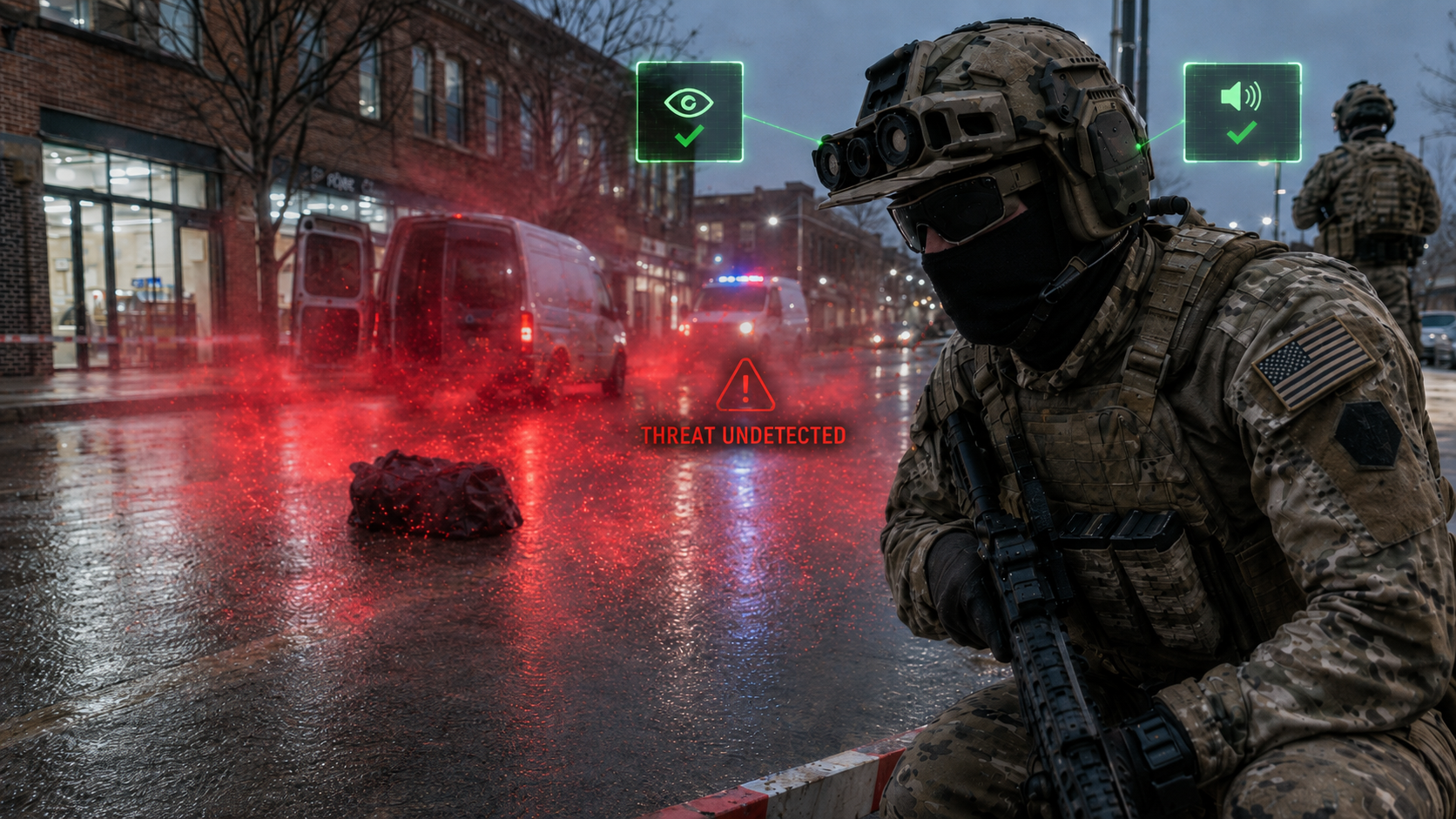
Governments across NATO and the Five Eyes spent more on defense in 2025 than at any point in recorded history.1 Counter-drone programs alone are forecast at US$12.6 billion in 2026, nearly doubling to US$24.1 billion by 2030.2 AI-driven analytics in defense is estimated at US$13.95 billion this year, projected to reach US$23.5 billion by the end of the decade.3
Two forces are driving this acceleration.
*Blockchain validator nodes are computers on a blockchain network that verify transactions and propose or confirm new blocks, following consensus rules. They help secure the network and may earn rewards for honest participation.
**An AI agent is software that can plan, decide, and take actions to complete tasks autonomously, using models, tools, and data—often coordinating steps, calling APIs, and adapting to results and user goals.

First, the threats are evolving faster than the countermeasures. Drone incursions over critical infrastructure are escalating across allied nations. Chemical, biological, and explosive threats are becoming harder to intercept with conventional surveillance. Autonomous systems are creating attack vectors that did not exist five years ago.
Second, the fentanyl crisis has turned border detection into a national security priority. Synthetic opioids are crossing borders in quantities that overwhelm traditional screening methods. The demand for portable, real-time detection in the field, not in a lab, is growing across defense, law enforcement, and public safety simultaneously.
The spending is there. The urgency is documented. But here is the gap that most investors have not considered.
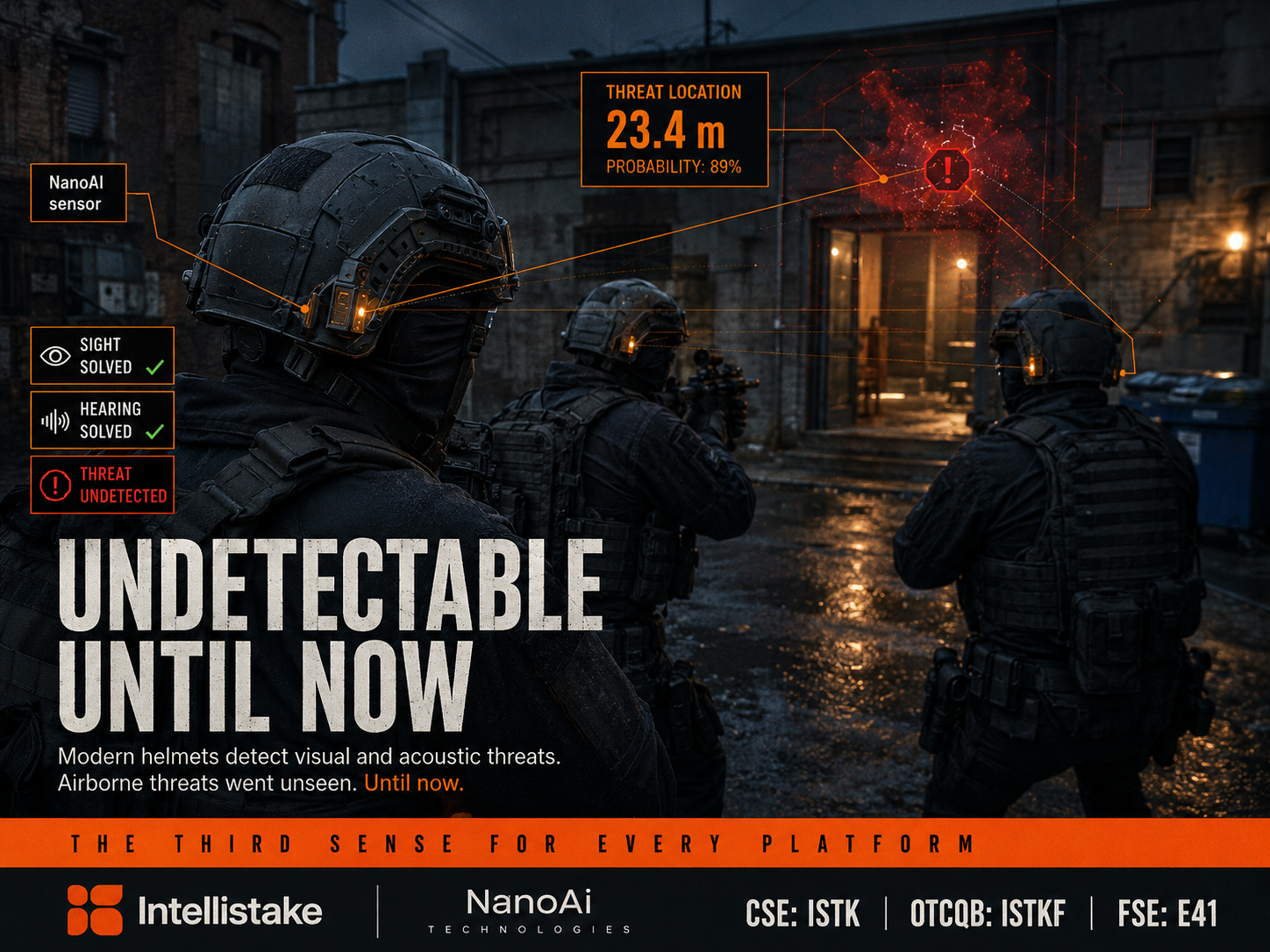
The Gap: Sight and Sound Are Solved. Detection Is Not.
Every major defense system deployed today is built around two senses: sight and sound. Cameras, radar, satellites, acoustic arrays, and drones. Billions of dollars invested into the ability to see and hear a threat from almost any distance.
But explosives leave chemical traces in the air. So does fentanyl. So do nerve agents, biological weapons, and toxic industrial chemicals. These threats are invisible to every camera, inaudible to every microphone, and undetectable by every radar system currently in the field.

The ability to detect what is chemically present in the air, in real time, from a portable device, before it reaches a person, a building, or a crowd, is still in the early stages. That is a wide-open capability gap inside a nearly US$50 billion combined market.
And that is the gap Intellistake Technologies Corp. (CSE: ISTK | OTCQB: ISTKF | FSE: E41) has moved to address.

The Acquisition: Intellistake (CSE: ISTK | OTCQB: ISTKF) Enters a Definitive Agreement to Acquire NanoAi Technologies
Intellistake (CSE: ISTK | OTCQB: ISTKF) has entered into a definitive agreement to acquire NanoAi Technologies, a company that builds portable nanotechnology-based air screening devices designed to detect explosives, chemical agents, biological threats, viruses, and illicit drugs.
NanoAi has completed more than 60,000 validation tests across its product line. The devices are lightweight, portable, and designed to operate discreetly. The company has designated product model numbers, including the SB-MU-12-424M, a multi-threat air screening device designed for drone deployment.
It serves clients across eight industries, from Defense and Aerospace to Healthcare to Maritime to Energy and Infrastructure.
NanoAi was founded by Craig Micklich, who served 12 years as a U.S. Navy SEAL before becoming a Senior Vice President at Morgan Stanley. That is detection technology built by someone who has operated in the environments where it would be deployed, and who understands the institutional capital markets required to scale it. The NanoAi team also includes a team member specializing in government contracting and public-private negotiations, a strong signal of where the company’s commercial strategy is pointed.
But the acquisition story does not end with what NanoAi has built. It starts with what Intellistake (CSE: ISTK | OTCQB: ISTKF) intends to build on top of it.

What Intellistake (CSE: ISTK | OTCQB: ISTKF) Brings: The AI and Software Layer That Turns Detection Into Decisions
Intellistake (CSE: ISTK | OTCQB: ISTKF) is a publicly traded AI and technology infrastructure company. It is not a hardware company. It is not a sensor manufacturer. It is an AI company with existing, deployed capabilities in enterprise software, data infrastructure, and intelligent automation.
Intellistake’s AI agent platform is already in production. The company holds a C$278,000 contract with PowerBank Corporation for an enterprise AI agent deployment, demonstrating that the technology is real and generating revenue.
The platform is built on RAG (retrieval-augmented generation) architecture, designed to process large volumes of data, extract actionable insights, and deliver real-time intelligence through enterprise-grade SaaS infrastructure.
The company also operates data pipeline infrastructure and has capabilities across AI agents, enterprise SaaS delivery, and intelligent data management.
Now consider what happens when you pair that software infrastructure with NanoAi’s detection hardware.
“A sensor reading, on its own, is data. It is not a decision. The value of detecting an explosive trace or a fentanyl signature depends entirely on what happens next: how fast the data is interpreted, how accurately the threat is assessed, and how quickly the right response is triggered.”
That is the layer Intellistake is designed to provide. The proposed acquisition is intended to create a sensor-to-decision capability:
NanoAi detects the threat, and Intellistake’s AI agents are intended to interpret, prioritize, and route the data to the right person at the right time. Neither company delivers this alone. The proposed combination is what makes the investment thesis compelling.
A New Layer of Defense Against Invisible Threats
To understand the scale of what this acquisition could enable, consider how threat detection works in the field today.
For invisible airborne threats, the primary tool is still a trained detection dog. Effective, but constrained by biology. One handler, one dog, one location, one shift.
Dogs fatigue after hours of continuous deployment. They require rest cycles, veterinary care, and ongoing training. They cannot be mounted on drones or robotic platforms. They cannot be deployed covertly. And they cannot screen multiple locations at the same time.
Detection Dogs (Current Standard)
- Require a trained Handler on site
- Fatigue after extended deployment
- Need rest, veterinary care, ongoing training
- Cannot operate covertly
- One dog, one location, one shift
- Cannot mount on drones or robots
NanoAi Sensor Technology
- Operates without a handler
- Designed to function without fatigue
- No biological care or training
- Lightweight, portable and discreet
- Could deploy across multiple sites at once
- Drone deployable models
NanoAi’s sensor technology is being developed at roughly the size of a thumbnail. Stackable for enhanced sensitivity. Concealable for covert operations. Designed to connect to different platforms and transmit detection data in real time.
If deployed at scale, a network of these sensors could provide persistent, multi-location coverage that no biological alternative can match. That is the kind of capability that defense departments, border agencies, and security operations could require as their budgets continue to expand.
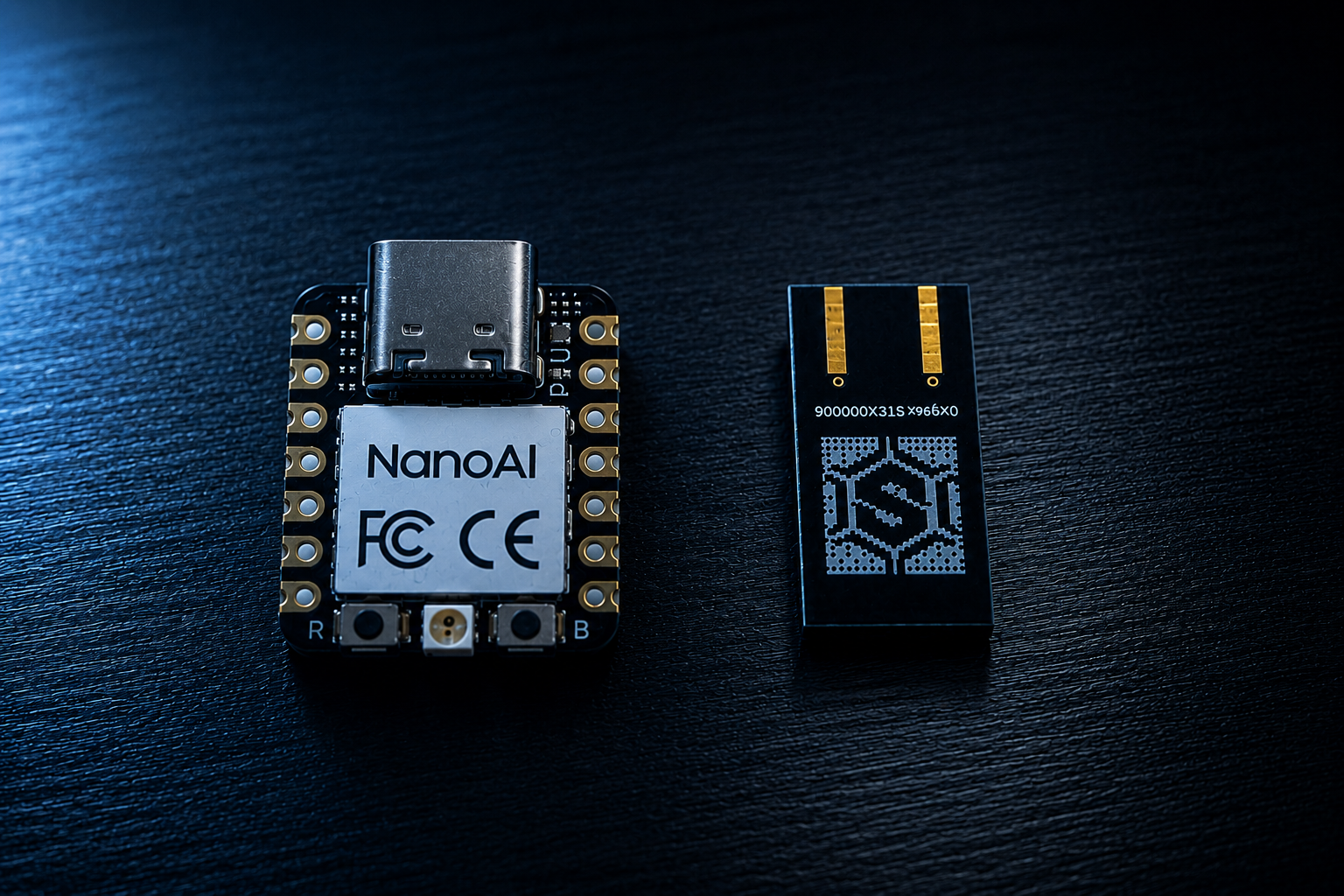
At this scale, the integration possibilities extend across nearly every form factor used in defense and security today.
Helmets and protective headwear. Body armor. Unmanned ground vehicles. Fixed infrastructure. Handheld field units. Wearable equipment for personnel on patrol.
Every platform that moves through an environment where invisible threats could be present becomes a potential carrier for persistent detection.

From Critical Infrastructure to Combat Zones
Think about where detection capability matters most. Border crossings that process thousands of people daily. Military bases that operate in contested territory. Airports and transit hubs that serve millions of passengers.
Government buildings. Maritime ports. Energy infrastructure. Contested airspace. These are environments protected by national-scale budgets, and those budgets are growing.
Canada has committed funding specifically to sovereign AI, sensor-fusion, and real-time situational-awareness technologies.4 Counter-drone spending is expected to nearly double between 2026 and 2030.2 NATO allies increased defense spending for the eleventh consecutive year in 2025.1
No government procurement contracts are currently confirmed. But the technology is designed for exactly these environments, and the markets it is intended to serve are the same markets absorbing tens of billions in new defense capital.

What This Acquisition Could Unlock
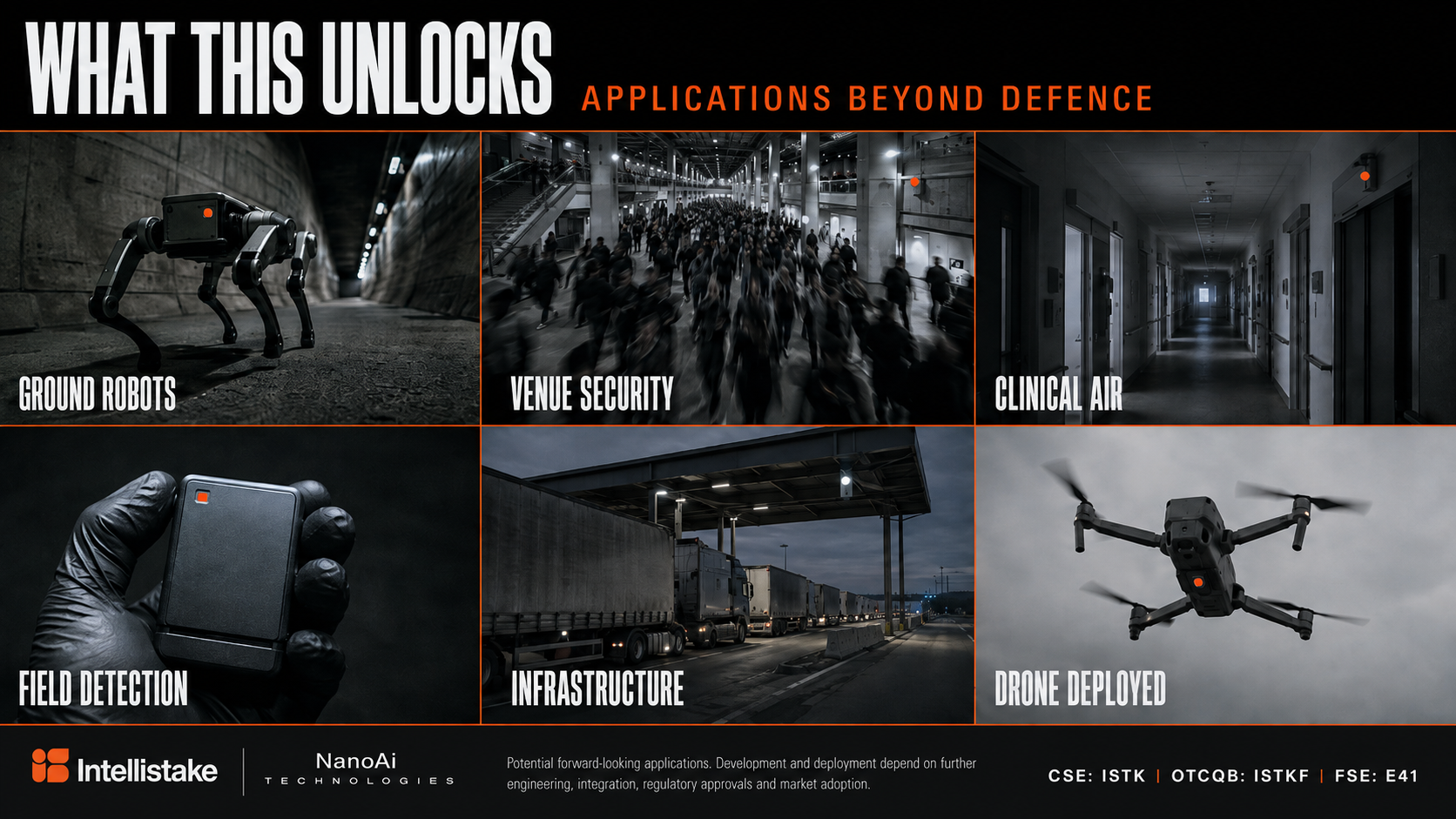
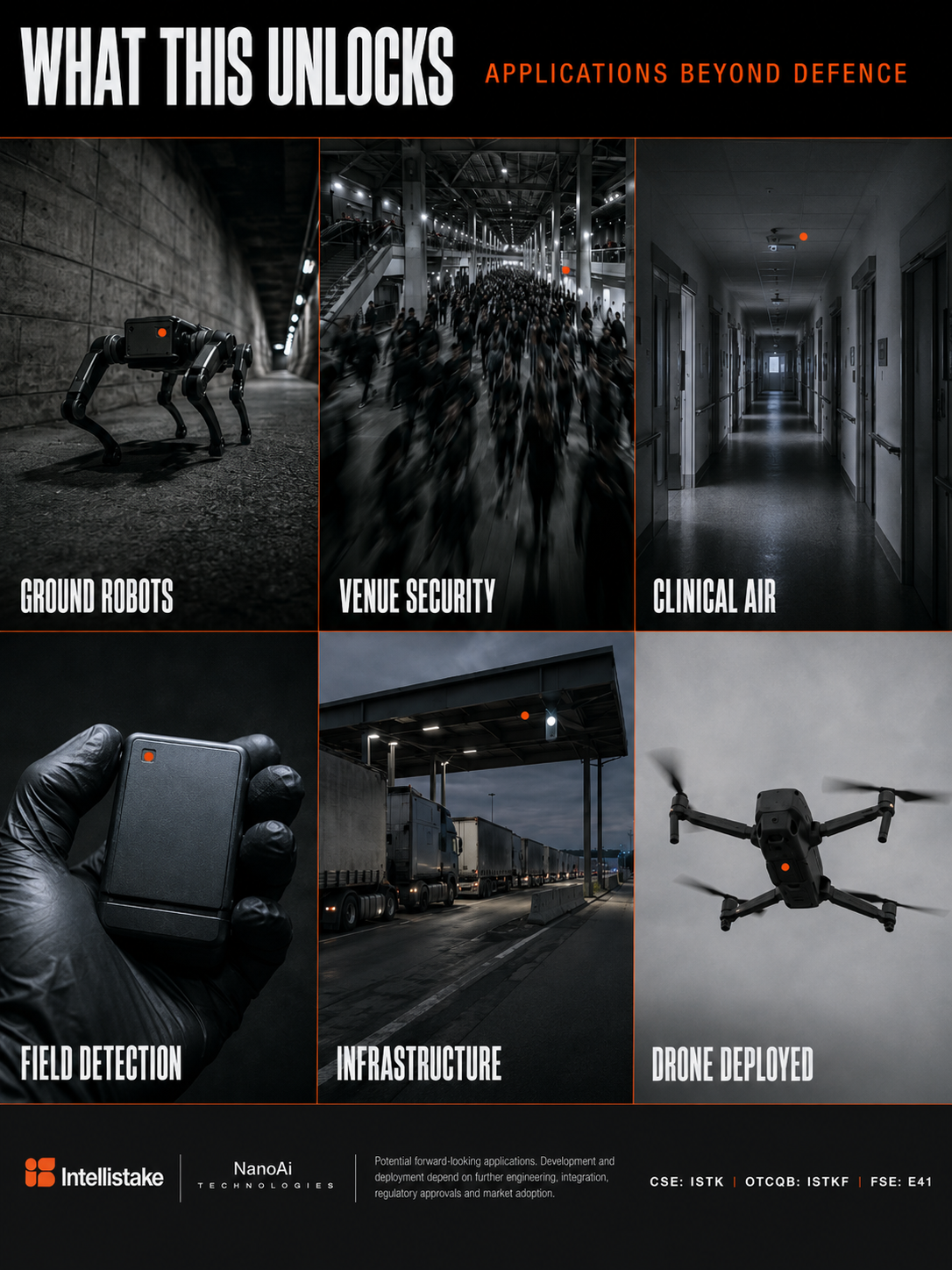
If a compact, portable sensor can detect explosives, fentanyl, biological agents, and chemical threats from the air, and if that sensor can be paired with AI software that interprets and routes the data in real time, the potential applications extend well beyond traditional defense.
Autonomous ground platforms. Imagine a sensor integrated into an unmanned ground system, giving a robotic unit the ability to detect explosive residues or chemical agents as it moves through a building, a tunnel, or a border zone. An extra sense designed to increase survivability for the personnel who would otherwise go in first.
Mass venue security. Compact, discreet sensors screening for explosives and illicit substances at stadiums, airports, and transit hubs. No checkpoints slowing foot traffic. No visible security infrastructure alerting a threat to its own detection.
Healthcare and early diagnostics. Air screening in clinical environments. Research into breath-based and airborne biomarker detection is advancing across the healthcare sector, and sensor technology designed for precision detection could contribute to early screening for pathogens and biological indicators.
Fentanyl and narcotics detection. A device small enough to carry or conceal, designed to identify fentanyl and other illicit substances during field operations. No detection dog. No specialized handler. No four-hour fatigue window.
Critical infrastructure monitoring. Persistent, unattended screening at borders, government buildings, energy sites, and ports. Detection that runs 24 hours a day without shift changes, without biological limitations, and without the human error that comes from fatigue.
Drone-deployed detection. NanoAi’s SB-MU-12-424M is designed for drone deployment. An airborne sensor platform that could carry threat detection capability into contested or hazardous environments where sending a person is too dangerous, too slow, or too exposed.
These represent potential forward-looking applications. Development and deployment would depend on further engineering, integration, regulatory approvals, and market adoption. No military procurement contracts or commercial deployments are confirmed unless expressly stated in company filings.
Completion of the acquisition of NanoAi remains subject to customary conditions including completion of satisfactory due diligence (including verifying title to the intellectual property of NanoAi), completion of the audit of financial statements of NanoAi, the company maintaining a minimum cash balance of $2 million and no objection from the Canadian Securities Exchange. Closing is targeted within 60 days from the date of the definitive agreement, subject to satisfaction of closing conditions in the definitive agreement.
Why Investors Are Watching Intellistake (CSE: ISTK | OTCQB: ISTKF) Right Now
- A Definitive Agreement to Acquire Proven Detection Technology
NanoAi has completed 60,000+ validation tests, holds designated product model numbers, serves eight industries, and has a drone-deployable device already built. This is hardware with a track record. - Existing AI and Software Infrastructure Ready to Deploy
Intellistake has an already deployed AI agent platform, a live enterprise contract, RAG architecture, and data pipeline infrastructure already in production. - A Sensor-to-Decision Capability Neither Company Delivers Alone
NanoAi detects the threat. Intellistake intends to interpret, prioritize, and route the data. The proposed combination is intended to create a capability that addresses a gap in nearly US$50 billion of combined defense markets. - Navy SEAL Founder With Government Contracting Leadership
NanoAi was built by a 13-year Navy SEAL veteran and former Morgan Stanley SVP. The team includes a VP specializing in government contracting and public-private negotiations. - Designed for the Environments Where Governments Spend Billions
Borders. Military bases. Airports. Critical infrastructure. The technology is designed for government-scale deployment in markets that are demonstrably expanding and actively funded. - One Publicly Traded Stock Covering Detection Hardware and AI Software
Subject to closing, ISTK is intended to give investors exposure to both the sensor technology and the AI intelligence layer through a single position on the CSE or OTCQB.

Intellistake (CSE: ISTK | OTCQB: ISTKF) is an early-stage company. The acquisition is subject to closing. Market growth does not guarantee company growth, and outcomes depend on execution, regulatory approvals, market adoption, and broader conditions. But the proposed combination targets a wide-open capability gap inside a market measured in tens of billions, backed by technology with 60,000+ validation tests, a team with government contracting expertise, and AI infrastructure that is already deployed with paying clients.
This Story Is Developing Now
Get updates on the proposed Intellistake-NanoAi acquisition and company milestones as they are announced.

CSE: ISTK
OTCQB: ISTKF
Website: https://www.intellistake.com/ | LinkedIn: https://www.linkedin.com/company/intellistake/ | Contact: https://www.intellistake.com/#CNTCT
Recent Press Releases
- Intellistake Secures Full Ownership of Prediction-Market Technology Gravity to Address Wider Infrastructure Needs
- Intellistake Opens Austen AI Content Platform to External Testers Ahead of Public Launch
- Intellistake Expands AI Capability Stack as Acquisition Target Singularity Venture Hub Develops Specialized AI Model for Real Estate and Data Center Sector
References
- Global military spending reached a record US$2.89 trillion in 2025, the 11th consecutive year of growth. NATO combined expenditure reached US$1.58 trillion, the highest on record. Source: Stockholm International Peace Research Institute (SIPRI) — sipri.org ↩ back to text
- Global counter-UAS market: forecast US$12.6 billion (2026), projected US$24.1 billion by 2030. Source: Unmanned Airspace — unmannedairspace.info ↩ back to text
- AI and analytics in defense market: estimated US$13.95 billion (2026), projected US$23.5 billion by 2030. Source: The Business Research Company — researchandmarkets.com ↩ back to text
- Canadian defense funding for sovereign AI, sensor-fusion, and real-time situational-awareness technologies. Source: Department of National Defence, Innovation for Defence Excellence and Security (IDEaS) — canada.ca ↩ back to text
NanoAi Technologies product and company information sourced from https://www.nanoaitechnology.com/
LEGAL DISCLAIMERS
This report contains “forward-looking information” concerning anticipated developments and events related to the Company that may occur in the future. Forward looking information contained in this report includes, but is not limited to, all statements in respect of the Company’s growth and development, expectations regarding prediction market growth, the operations and business segments of the Company and NanoAi, the functionality of the Company’s software, and its benefits, the details of the proposed acquisition of NanoAi, the conditions to completion of the proposed acquisition of NanoAi, the benefits of the acquisition of NanoAi and bridging the gap between emerging decentralized networks and real-world industry adoption.
In certain cases, forward-looking information can be identified by the use of words such as “expects”, “intends”, “anticipates” or variations of such words and phrases or state that certain actions, events or results “may”, “would”, or “might” suggesting future outcomes, or other expectations, assumptions, intentions or statements about future events or performance. Forward-looking information contained in this report is based on certain assumptions regarding, among other things, the Company will continue to have access to financing until it achieves profitability; the Company and NanoAi satisfy all conditions necessary to close the proposed transaction; the technology and blockchain industries in which the Company intends to focus its business in will grow at the rate and in the manner expected; the ability to attract qualified personnel; the success of market initiatives and the ability to grow brand awareness; the ability to distribute Company’s services; the Company creates strategies to mitigate risks associated with cryptocurrency price fluctuations; the Company remains compliant with all applicable laws and securities regulations and applicable licensing requirements; the Company engages and collaborates with local experts, as necessary, to address jurisdiction-specific matters and ensures compliance with foreign regulations to avoid penalties; the Company addresses any potential cybersecurity threats promptly and effectively; the ability of the Company to develop its technology, acquire customers and have revenue; the ability to successfully deploy the new business strategy as a result of the change of business. While the Company considers these assumptions to be reasonable, they may be incorrect.
Forward looking information involves known and unknown risks, uncertainties and other factors which may cause the actual results to be materially different from any future results expressed by the forward-looking information. Such factors include risks related to general business, economic and social uncertainties; failure of the Company and NanoAi to satisfy all conditions necessary to close the proposed transaction; failure to raise the capital necessary to fund its operations; inability to create strategies to mitigate the risks associated with cryptocurrency price fluctuations; the costs of regulation in the digital asset industries increase to the extent that the Company is no longer generating sufficient returns for shareholders; failure to promptly and effectively address cybersecurity threats; insufficient resources to maintain its operations on a competitive basis; and the actual costs, timing and future plans differs expectations; legislative, environmental and other judicial, regulatory, political and competitive developments; the inherent risks involved in the cryptocurrency and general securities markets; the Company may not be able to profitably liquidate its current digital currency inventory, or at all; a decline in digital currency prices may have a significant negative impact on the Company’s operations; the Company’s success may depend on the continued involvement of key personnel, including advisors, whose involvement cannot be guaranteed; institutional adoption of decentralized AI infrastructure remains uncertain and may not occur at the pace or scale anticipated; evolving regulatory frameworks, including those related to AI (such as Canada’s proposed Artificial Intelligence and Data Act) and prediction markets, may impose additional compliance burdens or restrict certain business activities; valuation figures are based on publicly available market data and internal assessments at the time of the referenced transactions and may not reflect current or future valuations; the volatility of digital currency prices; the inherent uncertainty of cost estimates and the potential for unexpected costs and expenses, currency fluctuations; regulatory restrictions, liability, competition, loss of key employees and other related risks and uncertainties; delay or failure to receive regulatory approvals; failure to attract qualified personnel, labour disputes; and the additional risks identified in the “Risk Factors” section of the Company’s filings with applicable Canadian securities regulators.
Although the Company has attempted to identify factors that could cause actual results to differ materially from those described in forward-looking information, there may be other factors that cause results not to be as anticipated. Readers should not place undue reliance on forward-looking information. The forward-looking information is made as of the date of this report. Except as required by applicable securities laws, the Company does not undertake any obligation to publicly update forward-looking information.
Recent News
- Intellistake Secures Full Ownership of Prediction-Market Technology Gravity to Address Wider Infrastructure Needs – July 22, 2026
- Intellistake Opens Austen AI Content Platform to External Testers Ahead of Public Launch – July 2, 2026
- Intellistake Technologies Corp. Marks Inaugural Year with Multi-Segment Infrastructure, Enterprise AI Contracts and the Launch of Its Austen AI Content Platform – june 11, 2026
- Intellistake Unveils Austen, an AI Content Platform for Founders, Operators and Agencies, and Opens Exclusive Beta Waitlist – June 2, 2026
- Intellistake Expands AI Capability Stack as Acquisition Target Singularity Venture Hub Develops Specialized AI Model for Real Estate and Data Center Sector – May 19, 2026
- Intellistake Marks Enterprise Milestone with IntelliScope AI Agent Platform Deployment on Sovereign Infrastructure for PowerBank – May 6, 2026
- Intellistake Scales Enterprise AI with Dedicated, Sovereign AI Data-Center Partnership with Singularity Compute – April 29, 2026
- Intellistake Delivers Production-Grade Al Agent System Under PowerBank Contract – April 8, 2026
- Intellistake Announces ST0x as Tokenized Securities Platform Investment Following European Prospectus Approval – April 1, 2026
- Leading University Formalizes Research Collaboration with Operator of Satellite Where Intellistake Holds a Strategic Investment Position – March 18, 2026
- Intellistake Advances Deployment Schedule on AI Software Development Contract with PowerBank Corporation – March 11, 2026
- Intellistake Announces C$1,573,000 Development Agreement with Prospect Markets to Build ‘Gravity’, a Liquidity Management System for Prediction Markets – March 3, 2026
- Intellistake Shares Technology Update on Orbit AI Genesis-1 Satellite – February 18, 2026
- Intellistake Highlights Singularity Venture Hub’s Contribution to Gaya Wallet’s Web3 Onboarding Infrastructure – February 11, 2026
- Intellistake Technologies Corp Secures C$278,000 AI Software Contract with PowerBank Corporation – February 5, 2026
- Intellistake Closes Investment in Tokenized Securities Technology Company – February 3, 2026
- Intellistake Announces Investment in Tokenized Securities Technology Company and Expression of Interest into CSA Project Tokenization – January 27, 2026
- Intellistake Technologies Corp. Advances Singularity Venture Hub Acquisition Following CSE Approval to Close – January 22, 2026
- Intellistake Technologies Corp. Appoints Founding Member of Revolut’s Crypto Team to Advisory Board – January 20, 2026
- Intellistake Technologies Corp. Signs Definitive Agreement to Acquire Premier AI-Web3 Venture Accelerator Singularity Venture Hub – December 24, 2025
- Intellistake Technologies Corp. Appoints Dr. Ben Goertzel, Leading Artificial Intelligence Researcher and SingularityNET Founder, to Advisory Board as a Special Advisor to the CEO to Advance Decentralized AI Integration December 17, 2025
- Intellistake Completes US$500,000 Investment in Orbit AI and Orbit AI Concludes Following Successful First Orbital Cloud Launch – Decemnber 11, 2025
- $2.17 Million in Proceeds Received by Intellistake from Warrant Exercises – December 10, 2025
Must Read OTC Markets/SEC policy on stock promotion and investor protection
COMPENSATION DISCLOSURE
EMC has been retained by Think Ink Marketing on behalf of Intellistake and paid $275,000. | Please read our full disclaimer